Friday, February 16, 2007
Seeing justice done
Step 4 of “How Courage Triumphs” picks up with Esther 7:9-10, which records the king’s judgment on Haman. There are truly evil people in the world and one day they will be judged by a righteous King. Justice was recently served in the case of Saddam Hussein. Here are some other examples of seeing justice done in the UK. You got any better ideas?


Thursday, February 15, 2007
Exaggeration
 Step 3 of “How Courage Triumphs” is based on Esther 7:1-6, and is titled by the LifeWay materials as State the Facts. Sgt Joe Friday on the popular Dragnet series frequently intoned, “All we want are the facts, Ma’am.” Refreshingly, that’s all Esther communicated to the king.
Thurman Seber makes the point that we should not “embellish our testimony”. Exaggeration is a first cousin to lying. Stick with the truth! Here is a story that cleverly comes to the defense of bats, which we are inclined to detest. I point it out only because it illustrates how exaggeration can lead to wrong conclusions. What are some example exaggerations you see in the headlines this week?
Wednesday, February 14, 2007
Stand out, Stand firm, Stand together, Stand against, Stand up
Step 2 of “How Courage Triumphs” is focused on Esther 5:1-3, which the LifeWay material titles, Step Out on Faith. These verses detail the action that followed Esther’s plan stated in 4:16. She acted in faith leaving the results to God.
Tonight at church, we prayed for a young man leaving shortly to serve in Iraq. His service in the United States Air Force illustrates to me similar courage and fortitude to that displayed by Esther. He trusts God whatever the outcome. As Paul described in Phil 1:27-30, this airman is standing courageously for Christ as he risks everything to serve his country in a foreign land.
Tonight at church, we prayed for a young man leaving shortly to serve in Iraq. His service in the United States Air Force illustrates to me similar courage and fortitude to that displayed by Esther. He trusts God whatever the outcome. As Paul described in Phil 1:27-30, this airman is standing courageously for Christ as he risks everything to serve his country in a foreign land.
Tuesday, February 13, 2007
Social loafing
Reading about courage, I came across the story of Kitty Genovese, who was murdered and not one of 38 witnesses came to her aid. Would you have helped Kitty?
Below I posted pictures of the first few PPT slides I’ll use in my lesson on “How Courage Triumphs”. Do you know any social loafers? , For example, it is easy to coast in a community where there is no responsibility.
To motivate a solution requires that people first get to know one another. With the community using this site in mind, one solution alternative is to link to your personal websites off this site. If you post your personal website in a comment, I'll add it to such a list. I’d pray that the Lord makes it a long one!


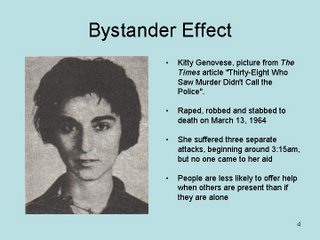
Below I posted pictures of the first few PPT slides I’ll use in my lesson on “How Courage Triumphs”. Do you know any social loafers? , For example, it is easy to coast in a community where there is no responsibility.
To motivate a solution requires that people first get to know one another. With the community using this site in mind, one solution alternative is to link to your personal websites off this site. If you post your personal website in a comment, I'll add it to such a list. I’d pray that the Lord makes it a long one!


Monday, February 12, 2007
How Courage Triumphs
When I first read the LifeWay material for the lesson “How Courage Triumphs,” it reminded me of Proverbs 26:27: “If a man digs a pit, he will fall into it; if a man rolls a stone, it will roll back on him.” Ironically, what Haman planned for Mordecai, happened to him. Politics aside we’ve recently witnessed the tables turned on press people as they are called as witnesses in a legal case.
Thursday, February 08, 2007
Shortcuts
Tabernacle Baptist Church in Cartersville, GA and First United Methodist Church in Newnan had at least three missionaries killed in a truck accident in Honduras this week.
These short-term missionaries were volunteers, Christians that risk a week or two away from home to make a difference for Christ in a foreign land.
Our pastor reminded us last night that there is no shortcut to the risk we take in living for Christ. The alternative is cowardice—a refusal to “chase after Jesus” in the race we run.
Here is a shortcut illustration. This post will cut short my blog this week due to unexpected travel and lack of Internet access. May God bless you as you prepare!
These short-term missionaries were volunteers, Christians that risk a week or two away from home to make a difference for Christ in a foreign land.
Our pastor reminded us last night that there is no shortcut to the risk we take in living for Christ. The alternative is cowardice—a refusal to “chase after Jesus” in the race we run.
Here is a shortcut illustration. This post will cut short my blog this week due to unexpected travel and lack of Internet access. May God bless you as you prepare!
Wednesday, February 07, 2007
Working together?
Picking up on my post yesterday, to complete slide 4, the attention-grabbing opening, you could use the LifeWay Extra suggestion to select and present prayer requests of missionaries to illustrate how service is sometimes risky. If you did this, what would do to complete slide 5 on making it personal for members? Anyone want to take a stab at that? We could get sort of a group effort going here!
Tuesday, February 06, 2007
Fill in the blanks
To help this week, I thought I’d be risky and post PowerPoint “starter slides” for the lesson, “When Service is Risky”. You can download the slides and look thru them to see my initial suggestions for structuring the lesson based on the LifeWay material.
I left blanks on the slides where you can make specific entries as you prepare this week. If you want to post your suggestions here so that others can see your ideas for completing the slides, please do!
I left blanks on the slides where you can make specific entries as you prepare this week. If you want to post your suggestions here so that others can see your ideas for completing the slides, please do!
Monday, February 05, 2007
When Service is Risky
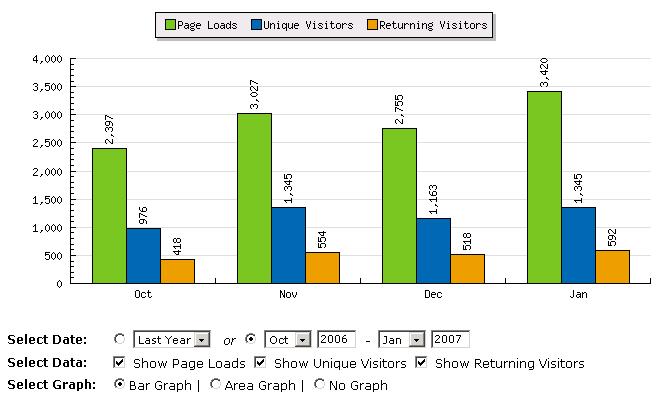 I regularly give an update on traffic to this site to demonstrate that many of you Explore the Bible teachers have a need for teaching ideas beyond what’s found in the good materials available from LifeWay. According to the chart, January ended with an upward trend in number of page loads (3,420), number of unique visitors (1,345) and number of returning visitors (592).
The last statistic is the one that encourages me most since an increase in returning visitors indicates greater numbers of visitors are finding the site helpful (else why come back?). However, the goal of this site, which has not been achieved (IMHO), is for teachers to inspire each other by sharing their illustrations, object lessons, or other teaching ideas in a positive way—sort of a virtual teachers meeting.
I’m not particularly interested in finding more Bible ‘commentary’ since I assume the LifeWay materials meet that need, or any number of other good sources. But if you have an idea of how to present your lesson that you’d like to share with lots of other teachers, please post it as a comment (or anywhere else on the web and then post a link to it here). Some of you have told me that posting is "risky service", but hey, it can't hurt, and it might help! Thanks!
This week we study “When Service is Risky”, based on Esther 3:1-4:17.
Saturday, February 03, 2007
This just in
A series of drawings that tell the story of Esther might interest you, or the movie Esther. I also uploaded my PPT slides for “When Life Turns Upside Down”. Hope these help someone!
Friday, February 02, 2007
Illustrating obedience
I don’t know what your thoughts are, but the key verse of the lesson “When Life Turns Upside Down” might be Esther 2:10. If Esther was anything, she was obedient. Why? She trusted Mordecai, so she did what he said.
I am thinking about illustrating obedience and the good that comes from it using an example of harnessing water power. Moving water (our will) flows along a channel (our listening/conforming to God’s commands) to operate (our taking action) a water wheel, for example. Following that, many good things happen. However, when water is out of it’s channel (our disobedient nature), destruction follows. What do you think?
I am thinking about illustrating obedience and the good that comes from it using an example of harnessing water power. Moving water (our will) flows along a channel (our listening/conforming to God’s commands) to operate (our taking action) a water wheel, for example. Following that, many good things happen. However, when water is out of it’s channel (our disobedient nature), destruction follows. What do you think?
Thursday, February 01, 2007
Here we go rafting again
Step 5 of When Life Turns Upside Down focuses on Esther 2:16-17,21-23, or making the most of an unexpected opportunity. Esther became a queen. Her uncle Mordecai becomes a hero when he uncovers a plot to assassinate king Xerxes. The Bible says the king “loved” Esther. So he made the most of an opportunity—to actually love the beautiful Esther and not simply possess her as a “trophy.”
Be Ready When Opportunity Knocks makes some excellent points on times when “opportunity comes knocking”. For example, do you routinely let others know of your willingness to help them?
We posted last December about responding, “when opportunity comes knocking.” I still like some of the ideas for response to opportunities in the white-water rafting article.
Be Ready When Opportunity Knocks makes some excellent points on times when “opportunity comes knocking”. For example, do you routinely let others know of your willingness to help them?
We posted last December about responding, “when opportunity comes knocking.” I still like some of the ideas for response to opportunities in the white-water rafting article.
Wednesday, January 31, 2007
To what end?
The Explore the Bible Adult Leader Guide, p 107 suggests reading an article about King Xerxes from the Biblical Illustrator Winter 2006-07 issue as background for teaching Step 3 (Esther 2:8-10) of this week’s lesson “When Life Turns Upside Down”. He was rich and powerful but failed in his attempt to concur the Greeks in revenge for their defeat of his father. Moreover, he was hot tempered and easily influenced by wrong advice.
Providentially, God put Esther in a position to also influence Xerxes in order to preserve the Jewish people. Not as dramatic, but as a young married couple, we briefly moved to Mississippi. Our daughter had a puzzling medical condition that previous doctors (a dozen) were unable to solve. Her new pediatrician diagnosed the problem correctly after only one exam. We thanked God and instantly new why He had allowed us to move to Mississippi.
If you ask someone to share a story of when God acted providentially in his or her life, follow up with the question “To what end do you think the events were allowed to transpire?” Surely, they should lead us to trust God in the midst of our circumstances.
Providentially, God put Esther in a position to also influence Xerxes in order to preserve the Jewish people. Not as dramatic, but as a young married couple, we briefly moved to Mississippi. Our daughter had a puzzling medical condition that previous doctors (a dozen) were unable to solve. Her new pediatrician diagnosed the problem correctly after only one exam. We thanked God and instantly new why He had allowed us to move to Mississippi.
If you ask someone to share a story of when God acted providentially in his or her life, follow up with the question “To what end do you think the events were allowed to transpire?” Surely, they should lead us to trust God in the midst of our circumstances.
Tuesday, January 30, 2007
Good coming out of a bad situation
 Step 2 of “When Life Turns Upside Down” in this week’s Explore the Bible lesson is titled Accept Unavoidable Changes, and is based on Esther 2:5-7. Esther’s sacred name, Hadassah means myrtle tree, which has a bloom that’s used to make perfume. I’m sure Esther brought the sweet fragrance of a God-pleasing response to the unexpected events that occurred in her life.
The story of The Little Grass Hut illustrates how good can come out of a bad situation.
Monday, January 29, 2007
When Life Turns Upside Down
 This week begins a series of “Explore the Bible” lessons from Esther. First up is “When Life Turns Upside Down (Mark Rathel’s commentary)”, based on Esther 1:1-2:23. From my perspective, study how Esther responded when her time came to meet with King Xerxes (2:15)? Did she follow one of these Seven tips for surviving sudden change? As a case study, also consider how Mordecai responded: (1) when his uncle died? (2) when Esther was taken away?
Friday, January 26, 2007
Thursday, January 25, 2007
A handful for sure
Should Christians observe a day of rest each week? This article is spot on IMHO. Read it carefully to help you prepare to teach Step 4 of “Keeping Commitments”, which is based on Nehemiah 13:15-18.
This lesson is shaping up to be challenging because members will need to contrast New Testament teaching on tithing and observance of the Sabbath with that as taught in the Old Testament. Principle versus command, or how do you plan to treat the topic of tithing and Sabbath observance?
This lesson is shaping up to be challenging because members will need to contrast New Testament teaching on tithing and observance of the Sabbath with that as taught in the Old Testament. Principle versus command, or how do you plan to treat the topic of tithing and Sabbath observance?
Wednesday, January 24, 2007
Cause and effect
 If “Keeping Commitments” were not important there wouldn’t be so many new articles mentioning “lack of financial support”. Make a list of interesting, recent failures due to lack of support and use it to demonstrate the results of poor follow through by those who make commitments.
P.S. Also made me think of "running on empty" and "shoestring operations".
It occurred to me that the topic of "Should Christians tithe?" might come up as part of your lesson.
Tuesday, January 23, 2007
Cleaning house
Part of “Keeping Commitments” was to use the temple the way God intended. When Nehemiah returned he discovered the misuse of the temple. The obvious parallel is that Christians should not misuse the temple of the Lord today. It may be time for some personal ‘house cleaning’? See the house cleaning custom observed in Italy as an interesting illustration.
Monday, January 22, 2007
Keeping Commitments
My lesson yesterday worked out very well. Since the topic was 'issue' based, I decided in the end to approach it by asking members the question "What does the Bible say?" about valuing life. I opened the lesson with four scenarios requiring members to give their advice in each case. I followed each answer with a question, "What's the premise of your argument?". I must admit, this created some anxiety, but I received so many positive comments afterwards from members that I concluded the lesson was successful in getting members to think deeply about their positions regarding 'valuing life'. My lesson was followed by a seven minute presentation from the director of a local CareNet facility, and her talk was well received, too. I hope you had good success, too!
This week's lesson, "Keeping Commitments" concludes our study of Nehemiah. This video shows how "good intentions" may not be what they seem.
This week's lesson, "Keeping Commitments" concludes our study of Nehemiah. This video shows how "good intentions" may not be what they seem.
Saturday, January 20, 2007
Valuing Every Life
Here are my PowerPoint slides for Sunday's lesson, "Valuing Every Life".
Hope I'm not posting them too late to be of use to you!
Hope I'm not posting them too late to be of use to you!
Friday, January 19, 2007
Last year
I went back and read "Live in Respect" on this blog, which was last year's "sanctity of life" lesson . If you teach a class with older members you may want to consider using it.
Years ago I memorized Psalm 139 as a means to understand the fear of the Lord and to meditate on the nature of God. We respect the Lord when we live obediently, and aware of God's presence at all times.
One idea I've had for teaching this lesson is to use a Q&A method that tests how well members are able to interpret and apply Scripture in a moral argument against abortion, euthanasia, embryo stem-cell research, etc. For example, consider the Scriptures cited in support of these Texas SBC resolutions. Are the Scriptures being interpreted according to good hermeneutical principles? The idea is to challenge members to rightly interpret the Bible's teaching regarding the sanctity of life.
Years ago I memorized Psalm 139 as a means to understand the fear of the Lord and to meditate on the nature of God. We respect the Lord when we live obediently, and aware of God's presence at all times.
One idea I've had for teaching this lesson is to use a Q&A method that tests how well members are able to interpret and apply Scripture in a moral argument against abortion, euthanasia, embryo stem-cell research, etc. For example, consider the Scriptures cited in support of these Texas SBC resolutions. Are the Scriptures being interpreted according to good hermeneutical principles? The idea is to challenge members to rightly interpret the Bible's teaching regarding the sanctity of life.
Wednesday, January 17, 2007
God accompanied Noah
Step 3 of “Valuing Every Life” continues application of Psalm 139 to the issue of the value God places on each life. You might consider using the Truth video in your class.
An inspiring story to share with members is that of baby Noah, an embryo rescued from Katrina flooded New Orleans. Wow! He can always tell of how God providentially cared for him. Here is another account of Noah’s birth.
An inspiring story to share with members is that of baby Noah, an embryo rescued from Katrina flooded New Orleans. Wow! He can always tell of how God providentially cared for him. Here is another account of Noah’s birth.
Tuesday, January 16, 2007
Dumbfounded
Step 2 of “Valuing Every Life” focuses on God and His knowledge of each of us as revealed in Psalm 139. I watched the National Geographic film Multiples this past Sunday and the video of what goes on in the womb is amazing. It made clear to me how a child in the womb feels, sees, and hears. Interestingly, in twins, for example, one twin becomes aware of and knows the other twin long before they are born.
Films from Sermonspice based on Psalm 139 might be useful to you in preparing Sunday’s lesson.
I don’t know about you, but I'm struggling to prepare for this lesson since I don't know what I can teach that everyone doesn't already know--the national tragedy of aborting 45 million children since 1973 is incomprehensible.
Films from Sermonspice based on Psalm 139 might be useful to you in preparing Sunday’s lesson.
I don’t know about you, but I'm struggling to prepare for this lesson since I don't know what I can teach that everyone doesn't already know--the national tragedy of aborting 45 million children since 1973 is incomprehensible.
Monday, January 15, 2007
Valuing Every Life
This Sunday is a special lesson entitled “Valuing Every Life” that corresponds to “Sanctity of Life” Sunday. This resource kit might be useful to you.
May God have mercy on us.
May God have mercy on us.
Saturday, January 13, 2007
Good idea!
Ron Moore of First Baptist, Clarksville, TN is doing a daily email devotion Monday through Friday of each week. According to Ron, they are short, easy to read, and have a challenge for each day.
The devotions are related to the Explore the Bible Sunday School materials, using the same scriptures as in the lesson. If you are interested in getting the devotions link to “first things first”.
The devotions are related to the Explore the Bible Sunday School materials, using the same scriptures as in the lesson. If you are interested in getting the devotions link to “first things first”.
Friday, January 12, 2007
Taken seriously
When we blurt out, “I mean what I’m saying!” we do so in sincerity if we want to be taken seriously. When we say something like, “Can I talk to you about a matter that’s on my mind?” we do so in sincerity if we want the other person’s undivided attention. Can you think of other situations where you want your sincerity to be clear? For example, when you write a business letter, you end it with “Sincerely,”.
In Step 4 of “Rededicating Lives”, the Israelites wanted to indicate the sincerity of their recommitment to God, so they made an agreement and on which they placed their personal seals. Read Nehemiah 9:38, and 10:28-29. What do you do to indicate that you mean business with God?
Google, or Yahoo! “Service Agreements” and you’ll see lots of examples that underscore business relationships in today’s world. Here is a list of general components in a service agreement. Thought question: Would you be willing to complete and sign a service agreement with God?
In Step 4 of “Rededicating Lives”, the Israelites wanted to indicate the sincerity of their recommitment to God, so they made an agreement and on which they placed their personal seals. Read Nehemiah 9:38, and 10:28-29. What do you do to indicate that you mean business with God?
Google, or Yahoo! “Service Agreements” and you’ll see lots of examples that underscore business relationships in today’s world. Here is a list of general components in a service agreement. Thought question: Would you be willing to complete and sign a service agreement with God?
Wednesday, January 10, 2007
Confession
Step 3 of “Rededicating Lives” comes from Nehemiah 9:1-2, which describes how the people repented publicly because of their encounter with God when his word was read aloud by Ezra. Essentially, their confession was a public demonstration of their collective private experience where they agreed with God about their sinful condition.
Zacchaeus offers a good example of public confession in the New Testament (Luke 19:7-9). If you need help capturing the video for playback in class, let me know.
How do you plan to illustrate repentance and public confession on Sunday?
Zacchaeus offers a good example of public confession in the New Testament (Luke 19:7-9). If you need help capturing the video for playback in class, let me know.
How do you plan to illustrate repentance and public confession on Sunday?
Tuesday, January 09, 2007
Relationship vs Faith
In “Rededicating Lives” from Nehemiah 8:1,5-6,9-10, Step 2 highlights a change in the Israelite’s form of worship from that of only making ritual sacrifices to that of also reading of God’s word publicly.
This triggers a question. As you practice your Christian faith, which is more central to obedience: a focus on your personal relationship with Jesus Christ or regularly reading the Bible?
Obviously, both are critical, but I wonder if we don’t sometimes put our focus on ‘personal relationship’ and neglect Scripture?
What is the role of reading Scripture in practicing your faith?
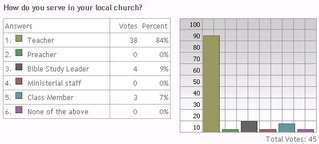
P.S. The results of last week's poll indicate that most of those who visit this site are teachers. Thanks for participating! Management
This triggers a question. As you practice your Christian faith, which is more central to obedience: a focus on your personal relationship with Jesus Christ or regularly reading the Bible?
Obviously, both are critical, but I wonder if we don’t sometimes put our focus on ‘personal relationship’ and neglect Scripture?
What is the role of reading Scripture in practicing your faith?
P.S. The results of last week's poll indicate that most of those who visit this site are teachers. Thanks for participating! Management
Monday, January 08, 2007
Rededicating Lives, Nehemiah 8:1-10:39
This week’s lesson “Rededicating Lives” is timely because we all fail and need to be reminded to confess our sin and recommit personally to God’s service. When a Christian sins, fellowship with the Lord is damaged even though the guilt of personal sin is eliminated through the work of Jesus Christ on the cross. As background for this lesson read Nehemiah 8:1-10:39.
A Christian friend of mine likens the Church in America today as “one giant baby nursery”. “Christians are simply refusing to grow up and mature in Christ,’ he claims. Ask class members to think critically about my friend’s statement. Have them explain why they would agree or disagree with his assertion.
P.S. I'll remove our poll tonight (see right side of page) and report the results tomorrow, so if you have not participated then today is your last chance!
A Christian friend of mine likens the Church in America today as “one giant baby nursery”. “Christians are simply refusing to grow up and mature in Christ,’ he claims. Ask class members to think critically about my friend’s statement. Have them explain why they would agree or disagree with his assertion.
P.S. I'll remove our poll tonight (see right side of page) and report the results tomorrow, so if you have not participated then today is your last chance!
Saturday, January 06, 2007
Manipulation today
Step 5 of “Devising Strategies” is based on Nehemiah 6:11-13. Nehemiah recognizes an attempt to ruin his good name. He wants to obey the Law and not sin (fears God) rather than run and hide.
I didn’t know the speculation that Nehemiah was a eunuch? Did you?
Are you beyond being manipulated today? Explain. How is your credibility as a teacher put on the line Sunday after Sunday?
I didn’t know the speculation that Nehemiah was a eunuch? Did you?
Are you beyond being manipulated today? Explain. How is your credibility as a teacher put on the line Sunday after Sunday?
Friday, January 05, 2007
Know thy enemy
Taken from Nehemiah 6:2-3, Step 4 of “Devising Strategies” illustrates how evil adapts its tactics in an attempt to thwart God’s purposes. However, Nehemiah didn’t negotiate with it (evil). Instead, he demonstrated he knew and understood his enemy very well.
How well do you know your enemy? Are you easily distracted by it (evil), or do you recognize it for what it is and refuse to fall prey to its tactics?
Have members name common distracters in their lives. Email? Phone? Radio? TV? How do these divert them from doing what they set out to do? Watch this video to see how even a baby can be distracted.
How well do you know your enemy? Are you easily distracted by it (evil), or do you recognize it for what it is and refuse to fall prey to its tactics?
Have members name common distracters in their lives. Email? Phone? Radio? TV? How do these divert them from doing what they set out to do? Watch this video to see how even a baby can be distracted.
Thursday, January 04, 2007
Devising defensive strategies
How do you respond to intimidation? Do you take steps to enhance your security (Neh. 4:12-13, 19-20, 22)? How do you prevent an intimidator from controlling you based on your responses?
The Lifeway Explore the Bible material offers an example of winning a game by a good defense (p.67). In football, for example, both teams constantly adjust their game tactics in response to each other’s actions. Both teams have the goal to win the game.
Computer security requires an adaptive defensive strategy against virus software.
How do you plan to illustrate Step 3 in this week’s lesson “Devising Strategies” ?
The Lifeway Explore the Bible material offers an example of winning a game by a good defense (p.67). In football, for example, both teams constantly adjust their game tactics in response to each other’s actions. Both teams have the goal to win the game.
Computer security requires an adaptive defensive strategy against virus software.
How do you plan to illustrate Step 3 in this week’s lesson “Devising Strategies” ?
Wednesday, January 03, 2007
Trash talk'n
While reading about how Sanballat taunted Nehemiah and the Jews in Nehemiah 4:1-2,4, I thought about today’s practice of “trash talk”. Read about “woffin” and “sledging” and consider using these means of taunting today in your discussion of Step 2 in this week’s lesson “Devising Strategies.”
Monday, January 01, 2007
Happy New Year!
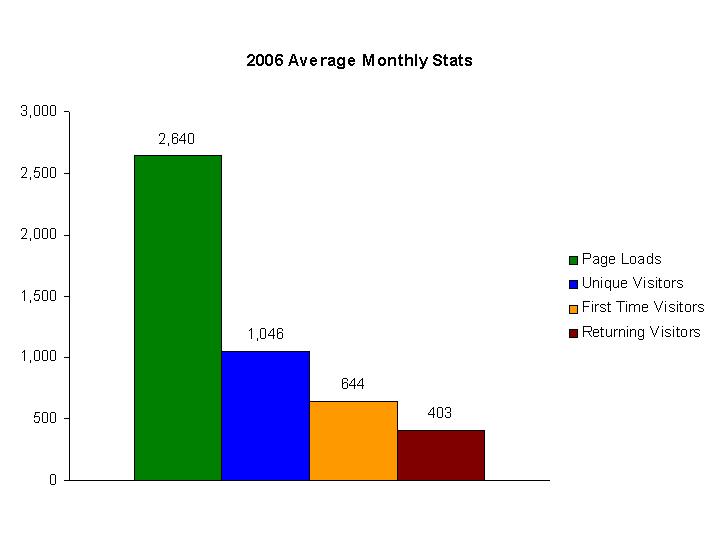 This site began in May 2005 and ended 2005 with an average 300 monthly visitors and 82 returning monthly users who looked at roughly 1,000 pages on average. Looking at the chart, this site ended 2006 with a good increase in these same average statistics! We had an average of over 400 returning monthly users out of an average 1046 unique visitors looking at over 2600 pages on average! Wow! Thank you Lord!
It is a blessing to discuss teaching God’s Word in a community of other believers who are interested in the LifeWay Explore the Bible lesson series.
Please participate in the poll to find out “what we do/how we serve” in our local church.
May 2007 be a great year for all of us—pray for the Lord’s return.
We are studying Nehemiah 4:1-7:73 this week in a lesson called, “Devising Strategies”.
Tuesday, December 19, 2006
Poll results
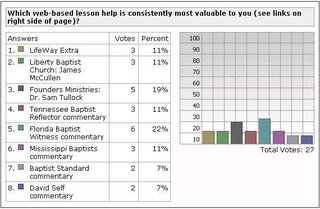
Below is a chart showing the results of our poll on lesson commentaries and helps that regularly appear on the web. I don't think too much can be concluded by examining the results, but thank you for participating!
My church is not having Bible study classes the next two weeks, so I'm going to take a break from blogging. May God bless you with a merry Christmas celebration of the birth of Christ and a fun welcoming of the new year!
My church is not having Bible study classes the next two weeks, so I'm going to take a break from blogging. May God bless you with a merry Christmas celebration of the birth of Christ and a fun welcoming of the new year!
Sunday, December 17, 2006
Time person of the year
Click here to download my slides for "Follow Godly Spiritual Leaders".
I'm sorry I posted these too late to be of help to most of you, but maybe you can critique them anyway?
I noticed that ordinary people were named as 'man of the year' by Time Magazine. Thanks for contributing to this blog. We are a very, very small part of what happens on the web, but we are a part, and for that we are thankful!
I'm sorry I posted these too late to be of help to most of you, but maybe you can critique them anyway?
I noticed that ordinary people were named as 'man of the year' by Time Magazine. Thanks for contributing to this blog. We are a very, very small part of what happens on the web, but we are a part, and for that we are thankful!
Friday, December 15, 2006
Diamond level support
 Step 4 of “Follow Godly Spiritual Leaders” is based on Ezra 10:1-5. Ezra needed to be encouraged after hearing about the unfaithfulness of the exiles. The people did this by confessing their sin and supporting Ezra as a leader.
Watch this video to see how one member encourages her spiritual leader.
I read a previous post on this blog about Spiritual Leadership. Ask members to send a note of encouragement to a Godly leader that has helped them know God better and they can recognize God at work in their lives.
You could show a picture of a diamond where the facets are clearly visible, and then label the facets with actions members can take that demonstrate support for a leader. The diamond’s value increases when the facets are cut correctly and then polished to perfection. Our support for Godly spiritual leaders can be rated on a scale ranging from a lump of coal (lowest) to a diamond (best).
Thursday, December 14, 2006
Mercy
In reading Ezra 9:1-2,4 for Step 3 of “Follow Godly Spiritual Leaders”, I was reminded of how our actions negatively impact not only our lives, but also the lives of those around us. For example, Ezra was devastated by the unfaithfulness of the exiles.
Simply put, ungodly behavior devastates the lives of others. Only God is righteous, however. May he have mercy on us and remake us to will and to act according to His good purpose.
Simply put, ungodly behavior devastates the lives of others. Only God is righteous, however. May he have mercy on us and remake us to will and to act according to His good purpose.
Tuesday, December 12, 2006
Interview a leader
For step 2 of “Follow Godly Spiritual Leaders”, consider interviewing one of your church’s pastors during class in a talk-show, host-guest format. Place a couple of stools in front of members and announce your guest. Both of you should take a seat and appear relaxed. Prepare a list of questions in advance (also share these with him so he’ll be prepared). Spend no more than 15 minutes. A sample list of questions follows. If you have some you’d like to suggest for our consideration, please post them!!
Start by saying, “Thank you [insert name] for agreeing to let us interview you today. As we just read in Ezra 7:8-10, God had his hand on Ezra and Ezra made choices to follow God’s word, and teach it to others. He was called by God as a leader of the people of Judah.”
1. Tell us how you became aware of God’s call on your life.
2. What did you do to prepare yourself for ministry?
3. Could you share with us a particular leader that you admire today and why?
4. May I open it up to members and allow them to ask you a question or two?
Start by saying, “Thank you [insert name] for agreeing to let us interview you today. As we just read in Ezra 7:8-10, God had his hand on Ezra and Ezra made choices to follow God’s word, and teach it to others. He was called by God as a leader of the people of Judah.”
1. Tell us how you became aware of God’s call on your life.
2. What did you do to prepare yourself for ministry?
3. Could you share with us a particular leader that you admire today and why?
4. May I open it up to members and allow them to ask you a question or two?
Monday, December 11, 2006
Follow Godly Spiritual Leaders
Our church has called a new pastor—Dr. David Flemming. He will start his ministry the first Sunday in January 2007, so this week’s lesson, “Follow Godly Spiritual Leaders” is particularly appropriate for members of Champion Forest Baptist Church. The lesson is taken from the last four chapters of Ezra.
One way to organize your lesson is to start by telling members that you want them to think of possible applications as you present an insightful review of the lesson chapters. Present your review (Have someone in the class help read selected verses, so that other voices are heard aside from yours), which shouldn't take more than half the allotted time for class.
Then apply the scriptures by asking members, “How do these chapters of Ezra apply to us today?” Then, as they are lead, allow members to speak about possible applications. Play off their comments and ask follow up questions. This should create good discussion about the verses as well as how they apply today.
One way to organize your lesson is to start by telling members that you want them to think of possible applications as you present an insightful review of the lesson chapters. Present your review (Have someone in the class help read selected verses, so that other voices are heard aside from yours), which shouldn't take more than half the allotted time for class.
Then apply the scriptures by asking members, “How do these chapters of Ezra apply to us today?” Then, as they are lead, allow members to speak about possible applications. Play off their comments and ask follow up questions. This should create good discussion about the verses as well as how they apply today.
Saturday, December 09, 2006
Doing the Lord's Work
Co-teacher Curt tells me, “We are doing the Lord’s work,” and that encourages me. I hope it encourages you. When we teach others what we’ve learned about God and His word, remember the Holy Spirit is the person really in control of learning. Yes, we prepare, make lesson plans, and pray about our classes, but in the end it is God that speaks His word thru the Spirit to the hearts and minds of learners (including us) to draw people to Him. We can have absolute confidence in God on this point. Keep truck’n and may God bless you!
Thursday, December 07, 2006
God given goal
 A good example of working with confidence in God is William Wilberforce's “confidence in God's power and purpose to end slavery through his efforts.” Share Wilberforce’s example in Step 4 of “Working with Confidence in God”. A powerful question is this, “What personal mission from God are you endeavoring to complete?” We must have a God-given goal wherein we can work with confidence in God.
Completing it will bring a time of joy. Wilberforce went home to be with God just three days after his four decade long struggle to rid England of slavery. Surely there was a party in heaven that day!
Wednesday, December 06, 2006
Make your intentions clear
The lesson “Working with Confidence in God” targets strengthening our confidence when serving God. Using Ezra 4:24,5:1-5, Step 3 deals with opposition from Persian rulers when the Jews were rebuilding the temple after the exile. When facing opposition I remind myself of Eph 6:11-13. However, what encourages me most is to remind myself of who I am in Christ.
As I read the material for this step, I thought about the need to make our intentions clear. We face opposition sometimes when our intentions are misunderstood. For example, the Samaritans believed the Jews intended to establish national boundaries in existence prior to the Babylonian captivity. However, the Jews were only rebuilding the temple as Cyrus degreed. Has there been a time when your intentions were unclear, and that misunderstanding lead to opposition of your efforts?
As I read the material for this step, I thought about the need to make our intentions clear. We face opposition sometimes when our intentions are misunderstood. For example, the Samaritans believed the Jews intended to establish national boundaries in existence prior to the Babylonian captivity. However, the Jews were only rebuilding the temple as Cyrus degreed. Has there been a time when your intentions were unclear, and that misunderstanding lead to opposition of your efforts?
Tuesday, December 05, 2006
Stymied again!
I’ve been curious about what gave rise to the hatred between the Jews and Samaritains (eg. John 4:9). The passage from Ezra 4:4-5, comprising Step 2 of “Working with Confidence in God,” gives insight into the matter—the Smitarians discouraged the Jews and bribed officials to frustrate their rebuilding plans. David Self’s commentary on the lesson offers some needed background to understand the racial hostility between these two groups of people.
The word stymie used to describe an interesting golf shot, but it’s also used to mean hinder, or block accomplishment. How do you relate to people that deliberately stimie your progress? Do you end up hating one another as the Jews and Smaritians did?
Have your good intentions ever been stymied by someone? Has your career been stymied by a particular boss? Do you keep trying or simply quit? Do you seek wisdom from a leader, from Scripture, or simply ‘wing it’? Do you consider good alternatives, or get frustrated?
The word stymie used to describe an interesting golf shot, but it’s also used to mean hinder, or block accomplishment. How do you relate to people that deliberately stimie your progress? Do you end up hating one another as the Jews and Smaritians did?
Have your good intentions ever been stymied by someone? Has your career been stymied by a particular boss? Do you keep trying or simply quit? Do you seek wisdom from a leader, from Scripture, or simply ‘wing it’? Do you consider good alternatives, or get frustrated?
Monday, December 04, 2006
Let go!
I thought about the phrase "cry Uncle" while I was reading the material for this week's lesson "Working with Confidence in God", which is based on Ezra 4:1-6:22. Perhaps discussing the origin of the term might make an interesting introduction to the lesson? See Please Release Me (scroll down the bottom of the page).
Below a quote taken from a post on Wordwizard Clubhouse.
"The expression variously appears CRY/HOLLER/SAY UNCLE! and is an Americanism which is a request for a concession of defeat – to beg someone to stop, to surrender. UNCLE is the verbal concession the defeated party is require to say before being let go. But no one knows its origin for sure, so all we actually have is educated guesses [however, the journal ‘American Speech’ under Cassell’s and the 1980 quote (see below) is probably the most authoritative]. It first appeared as a schoolyard expression in around 1900 and began to be used figuratively by mid-century.
________________________________________________
Facts on File Encyclopedia of Word and Phrase Origins
UNCLE!: ‘To say’ or ‘cry uncle’ has since the beginning of this century meant ‘to give up, to surrender, to say you’ve had enough.’ Apparently it is of schoolboy origin, at least it is most used by schoolboys when fighting, especially when one has another pinned helplessly on the ground. For about 30 years the cry ‘give’ has been more common in the New York City area, but one still hears the earlier expression. [[From personal experience, I can tell you that in N.Y.C. ‘give’ goes back at least 50 years]]. Why ‘uncle’ was chosen by kids is anybody’s guess; there probably is no good reason unless a defeated boy originally had to curse his uncle, just a s bullies often make their victims curse their mothers and sisters before letting them go. Which is no more than a guess. ‘Cavy!’ a similar expression not heard anymore, is said to date back to Tudor times, a corruption of the Latin ‘peccavi,’ meaning ‘I have sinned, I am wrong.’
________________________________________________
Random House Dictionary of America’s Popular Proverb’s and Sayings
SAY UNCLE Surrender! This expression originated in the United States in about 1900. Lexicographer Charles Earl Funk [[of the Funk and Wagnall dynasty]] thinks that the phrase may have some Latin connection. When a Roman boy was in trouble, he cried ‘patrue mi Patruissime’ (‘Uncle my best of uncles’). CRY/HOLLER/YELL is a variant, which is always used figuratively.
________________________________________________
Cassell’s Dictionary of Slang
CRY/HOLLER/SAY UNCLE verb [1910s and still in use]: To beg someone to stop an action, to surrender. [“‘uncle’ in this expression is surely a folk etymology, and the Irish original of the word is ‘anacol’ (‘anacal,’ ‘anacul’) ‘act of protecting; deliverance; mercy, quarter, safety,’ a verbal noun from the Old Irish verb ‘aingid,’ protects.” (from ‘American Speech’ LI, 1976)] [[see 1980 quote below for fuller statement]]"
Below a quote taken from a post on Wordwizard Clubhouse.
"The expression variously appears CRY/HOLLER/SAY UNCLE! and is an Americanism which is a request for a concession of defeat – to beg someone to stop, to surrender. UNCLE is the verbal concession the defeated party is require to say before being let go. But no one knows its origin for sure, so all we actually have is educated guesses [however, the journal ‘American Speech’ under Cassell’s and the 1980 quote (see below) is probably the most authoritative]. It first appeared as a schoolyard expression in around 1900 and began to be used figuratively by mid-century.
________________________________________________
Facts on File Encyclopedia of Word and Phrase Origins
UNCLE!: ‘To say’ or ‘cry uncle’ has since the beginning of this century meant ‘to give up, to surrender, to say you’ve had enough.’ Apparently it is of schoolboy origin, at least it is most used by schoolboys when fighting, especially when one has another pinned helplessly on the ground. For about 30 years the cry ‘give’ has been more common in the New York City area, but one still hears the earlier expression. [[From personal experience, I can tell you that in N.Y.C. ‘give’ goes back at least 50 years]]. Why ‘uncle’ was chosen by kids is anybody’s guess; there probably is no good reason unless a defeated boy originally had to curse his uncle, just a s bullies often make their victims curse their mothers and sisters before letting them go. Which is no more than a guess. ‘Cavy!’ a similar expression not heard anymore, is said to date back to Tudor times, a corruption of the Latin ‘peccavi,’ meaning ‘I have sinned, I am wrong.’
________________________________________________
Random House Dictionary of America’s Popular Proverb’s and Sayings
SAY UNCLE Surrender! This expression originated in the United States in about 1900. Lexicographer Charles Earl Funk [[of the Funk and Wagnall dynasty]] thinks that the phrase may have some Latin connection. When a Roman boy was in trouble, he cried ‘patrue mi Patruissime’ (‘Uncle my best of uncles’). CRY/HOLLER/YELL is a variant, which is always used figuratively.
________________________________________________
Cassell’s Dictionary of Slang
CRY/HOLLER/SAY UNCLE verb [1910s and still in use]: To beg someone to stop an action, to surrender. [“‘uncle’ in this expression is surely a folk etymology, and the Irish original of the word is ‘anacol’ (‘anacal,’ ‘anacul’) ‘act of protecting; deliverance; mercy, quarter, safety,’ a verbal noun from the Old Irish verb ‘aingid,’ protects.” (from ‘American Speech’ LI, 1976)] [[see 1980 quote below for fuller statement]]"
Saturday, December 02, 2006
When opportunity comes knocking
I was thinking about how to close this lesson in a meaningful way. Life presents all of us a series of opportunities that we react to based on a number of different factors. What opportunities matter to you? Which ones are too big to turn down? Are there some that you just can’t pass by?
We have friends whose home was destroyed by Katrina. As soon as it was permitted our friends returned to New Orleans to begin rebuilding their home. Just as the Hebrews wanted to rebuild Jerusalem and the temple, our friends were eager to rebuild New Orleans and their home.
You can search Google News for stories concerning rebuilding N.O. or a home there and share it with your class. As an aternative, here is a link to a secular article that uses white-water rafting to illustrate aspects of responding to opportunities in life.
The following bar chart shows the usage of this site as determined by Statcounter.com. What happened in October is a bit of a mystery, but in November, returning visitors continued to rise. For this I am thankful! I appreciate all of you who visit here and encourage me. Thanks to all who help make this site a place where Bible teachers can help each other prepare.

We have friends whose home was destroyed by Katrina. As soon as it was permitted our friends returned to New Orleans to begin rebuilding their home. Just as the Hebrews wanted to rebuild Jerusalem and the temple, our friends were eager to rebuild New Orleans and their home.
You can search Google News for stories concerning rebuilding N.O. or a home there and share it with your class. As an aternative, here is a link to a secular article that uses white-water rafting to illustrate aspects of responding to opportunities in life.
The following bar chart shows the usage of this site as determined by Statcounter.com. What happened in October is a bit of a mystery, but in November, returning visitors continued to rise. For this I am thankful! I appreciate all of you who visit here and encourage me. Thanks to all who help make this site a place where Bible teachers can help each other prepare.

Thursday, November 30, 2006
Take God's perspective into account
In the Baptist Standard, Howard Anderson’s commentary on “Seizing New Opportunities” includes a pertinent question: Can an opportunity that looks good be contrary to God’s will? Why do I bring this up?
The LifeWay material for Step 4 is based only on Ezra 3:10-11, but another perspective is gained by also considering Ezra 3:12. Some of the older Israelites were saddened at the sight of the new foundation (see also Haggai 2:3). It was like nothing compared to the previous temple. The people who had never seen Solomon’s temple, however, were overjoyed.
Where in your Church do older people see opportunities differently that younger people? The key is to observe their response. We may not be able to pick our circumstances, but we can choose our response. Paul exhorted believers to “Be joyful always” (1 Thes 5:16) because God is in control.
The LifeWay material for Step 4 is based only on Ezra 3:10-11, but another perspective is gained by also considering Ezra 3:12. Some of the older Israelites were saddened at the sight of the new foundation (see also Haggai 2:3). It was like nothing compared to the previous temple. The people who had never seen Solomon’s temple, however, were overjoyed.
Where in your Church do older people see opportunities differently that younger people? The key is to observe their response. We may not be able to pick our circumstances, but we can choose our response. Paul exhorted believers to “Be joyful always” (1 Thes 5:16) because God is in control.
Wednesday, November 29, 2006
Wow! That was fast!
Step 3 of “Seizing New Opportunities” is focused on Ezra 3:1-3. To help members understand just how rapidly the Hebrews seized the opportunity to worship God in their own homeland, I would also read verse Ezra 3:6. They deemed it more important to worship God than to lay the foundation of the temple. Their actions demonstrated their priorities. Look at how fast a gal can stack paper cups. Compare that to how fast you can stack up worship to God when given an opportunity!
Tuesday, November 28, 2006
Half-full attitude
 To learn to respond to a God-given opportunity, which is Step 2 of “Seizing New Opportunities”, we have to first learn to recognize an opportunity when presented to us.
We are numbed by everyday activities and tend to miss what might be happening around us. Since God operates thru the local church, make a list of activities happening in your church. For example, in my church we are anticipating the arrival of a new pastor. That would be an opportunity on my list.
Present your list of ‘what’s happening’ to members and ask them to rate each one with the symbol “half-full”, or “half-empty”. The half-full rating indicates the opportunity is on the way up, whereas, the half-empty rating indicates the opportunity has past its peak and is on the way down. Summarize the ratings verbally, but point out how they indicate one’s attitude. Learning to react positively will help us be open to opportunities as God presents them to us.
Monday, November 27, 2006
Tracing God's Hand
 I’m excited about studying Ezra since I’m not that familiar with the book. The idea of the first lesson “Seizing New Opportunities” from Ezra 1:1-3:13 is to see God’s hand in the opportunities that come our way in life. You might consider the following idea as you introduce the lesson. Post a regional map where everyone can see it and put your hand on the map and trace the outline of your hand with a marker. Emphasize to members that by studying Ezra we want to learn to recognize God hand in our lives thru the opportunities presented to us. Make the point that only by seizing them can we experience the blessings God intends for us. Done right, you can get everyone expecting to experience the blessings of God at work in their lives. How exciting is that?!
In addition to the study questions by Sonshine linked to above, she also posted a background guide to Ezra that might help you. Send a note to Sonshine and thank her!! The blessing of reading her material is a God given opportunity we should seize today!
Saturday, November 25, 2006
Slides for Love One Another
Click here to download the PPT slides I created to use in teaching the lesson "Love One Another".
I pray that your lesson pleases God and that He blesses every member with complete understanding of His will to love one another.
I pray that your lesson pleases God and that He blesses every member with complete understanding of His will to love one another.
Friday, November 24, 2006
Finishing Hebrews
 As the kids piled into the car to leave after the holiday, we shouted last minute exhortations. “Remember to order the carpet. Remember to change your oil and get your tires rotated. Do not neglect your health, so schedule that physical exam.”
As the writer of Hebrews closed his letter, he crammed Hebrews 13 with final exhortations. Love one another. Live pure lives. Imitate and assist leaders. Remember Christ is the same yesterday and today and forever, so his purpose in the life of a believer has not changed.
Step 5 of the lesson “Love One Another” takes its point from Hebrews 13:17-19, which is an exhortation to obey and pray for responsible leaders. The writer of Hebrews closed the book with an inspirational prayer for his readers (Hebrews 13:20-21).
How do you plan to close your lesson? It’s the last lesson in our series on Hebrews. Are you going to summarize the main teaching points of the entire letter? Do you plan to ask people what they have learned by studying the book? How do you plan to end the sentence, “Let me finish by saying…”.
Thursday, November 23, 2006
More to the story
Sam Tullock points out in his commentary on “Love One Another” that the passage Hebrews 13:1-25 addresses a broader range of topics than love. He goes on to say, “Above all, this week’s lesson highlights the centrality of Christ to the life of believers.” Step 4 verses Hebrews 13:12-16 underscore his point. We identify with Christ, “bearing the disgrace he bore,” and through him, continually praise and thank God.
Wednesday, November 22, 2006
Follow the leader
This week I decided to use the LifeWay Adult Extra material to help with this week’s lesson, entitled “Love One Another.” Step 3 is titled ‘Imitate Leaders’, which brings to mind the kids game, “follow the leader”. The step references Hebrews 13:7-8, which says that leaders spoke “God’s word”.
 For fun, play “follow the leader” this way. Ask, a member to say out loud any single verse they know from memory. Afterwards, ask if any member of the class can also say the same verse from memory, and then allow some person to quote the verse. Then ask that person to say a new (single) verse from memory. Again, ask if a member of the class can follow that leader and say the verse. Continue a bit before stopping the game. The game illustrates imitating leaders who speak the Word to us.
Happy Thanksgiving!
 For fun, play “follow the leader” this way. Ask, a member to say out loud any single verse they know from memory. Afterwards, ask if any member of the class can also say the same verse from memory, and then allow some person to quote the verse. Then ask that person to say a new (single) verse from memory. Again, ask if a member of the class can follow that leader and say the verse. Continue a bit before stopping the game. The game illustrates imitating leaders who speak the Word to us.
Happy Thanksgiving!
Tuesday, November 21, 2006
Simple to say, hard to do
Step 2, based on Hebrews 13:1-6, is titled Love People in the LifeWay Leader Guide for this week’s lesson “Love One Another.” This is easy to say, but hard to do. The Lord gave us a direct command to “love one another” (John 15:12) and to “love your neighbor as yourself” (Matthew 22:39). We may not know what all that means, but we can allow Scripture to guide us to emulate Christ.
Jesus added, “as I have loved you”, so he set the example for us to follow. Hebrews 13:1-6 lists several ways to demonstrate love as does 1 Cor 13:4-7. You might consider using the Adult Extra suggestion for this step, which I like.
An alternative is to put the focus on verse 6.
Jesus added, “as I have loved you”, so he set the example for us to follow. Hebrews 13:1-6 lists several ways to demonstrate love as does 1 Cor 13:4-7. You might consider using the Adult Extra suggestion for this step, which I like.
An alternative is to put the focus on verse 6.
Monday, November 20, 2006
What's love?
In his commentary on this week’s lesson from Hebrews 13:1-25, “Love One Another,” Mark Rathel points out rather pointedly the wrong teaching that phileo love is a lower level love than agape love. Agape love is “love by choice”, whereas phileo love involves the emotions. God demonstrated both types of love toward humanity.
The word love is so misunderstood, especially given its importance—it’s the royal law of Christ (John 13:34, James 2:8, 1 John 4:21). I recommend a healthy discussion to define love. Otherwise, listeners will have their own definition. Anyone care to take a stab at defining it?
The word love is so misunderstood, especially given its importance—it’s the royal law of Christ (John 13:34, James 2:8, 1 John 4:21). I recommend a healthy discussion to define love. Otherwise, listeners will have their own definition. Anyone care to take a stab at defining it?
Friday, November 17, 2006
Serve, not be served
 Step 5, Hebrews 12:17-29: Unlike the ancient Jews who trembled with fear and dared not approach God, the Hebrew Christians could boldly come under a new covenant redeemed by the blood of Christ to worship the living God in the company of others. The writer warned them not to turn away from such an opportunity, but instead be thankful and not presume on an awesome God.
Read Psalm 19:13 and discuss with members what it means to presume on God.
Thursday, November 16, 2006
Keep on keep'n on
 Step 4 of “Persevere Amid Difficulty” comes from Hebrews 12:12-16, which highlights the obligations of a believer to help others in the race toward Christian maturity and possible dangers to avoid along the way.
We are to strengthen our resolve, remove obstacles for others and avoid getting sidetracked.
One measure of maturity is how quickly you offer help to another Christian that falls into difficulty. To apply verses 12 and 13 show a list of names of people from the Wednesday night prayer service and ask members to consider ways they can help and encourage others in difficulty.
Wednesday, November 15, 2006
Cut and run
Do you see a present, difficult circumstance as discipline from the Lord? If so, take comfort and be not disheartened. Step 3 in this week’s lesson “Persevere Amid Difficulty“ comprises verses Hebrews 12:4-8. We are called to endure hardship as discipline from the Lord, and not grow weary. It’s time to worry if you don’t have any problems!! A child never disciplined never learns self-discipline. Thank God for disciplining us.
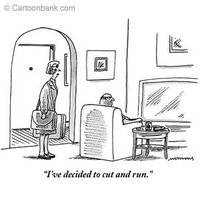 Circumstances reveal our character. How do you react in tough times? Do you cut-and-run (quit), or persevere? Our goal is to learn to endure, but how do we teach that?
The writer of Hebrews used positive examples in chapter 11, and the supreme example of Christ going to the cross at the start of chapter 12. You could use ‘negative’ examples, i.e. discuss situations where people do cut-and-run as depicted in the cartoon example.
 Circumstances reveal our character. How do you react in tough times? Do you cut-and-run (quit), or persevere? Our goal is to learn to endure, but how do we teach that?
The writer of Hebrews used positive examples in chapter 11, and the supreme example of Christ going to the cross at the start of chapter 12. You could use ‘negative’ examples, i.e. discuss situations where people do cut-and-run as depicted in the cartoon example.
Tuesday, November 14, 2006
Be honest about unbelief
What discourages you to the point of “unbelief?” Step 2 of “Persevere Amid Difficulty” considers verses Hebrews 12:1-3, which mentions the “the sin that so easily ensnares”. Read these verses and ask members what tempts them not to believe in today’s world. Have an honest discussion and pray that the Holy Spirit demolishes strongholds, or arguments against the knowledge of God, which leads not to unbelief, but faith in Christ.
Monday, November 13, 2006
Persevere Amid Difficulty, Hebrews 12:1-29
This week’s lesson, “Persevere Amid Difficulty”, is taken from Hebrews 12:1-29. When I think of perseverance I’m reminded of the Biblical phrase “set my face like flint”, which appears in Isaiah 50:7. We are told in Luke 9:51 that Jesus “set his face” to go to Jerusalem.
Daniel also “purposed in his heart”. In your life, have you ever “set your face” to accomplish a goal? Describe what it felt like. What obstacles did you overcome?
Daniel also “purposed in his heart”. In your life, have you ever “set your face” to accomplish a goal? Describe what it felt like. What obstacles did you overcome?
Saturday, November 11, 2006
In case your interested...
Click here to download the PPT slides I created to use tomorrow for teaching the lesson "Exhibit Your Faith".
Let me know if PPT material like this is useful to you.
Let me know if PPT material like this is useful to you.
Remain steadfast, eh?
 In the last step of “Exhibit Your Faith”, taken from Hebrews 11:17-19,24-26, the writer explained the details of how Abraham and Moses operated in faith. Abraham believed (faith) that God would raise Isaac from the dead, and Moses looked into the future (by faith) to his reward and then chose to suffer disgrace by abandoning Pharaoh’s house.
Each man took actions that demonstrated his faith in the Lord, but get this: neither received what was promised during his earthly life! That’s the point. Don’t miss it.
If nothing else, we should at least remain steadfast and put into action today the Lord’s command to love one another because we know (by faith) that Jesus Christ will return one day. Love's actions reveal our faith like windmill turns demonstrate the wind's presence.
What acts of love for one another can you do today? Take a walk together? Go out to dinner together? Write a note? Give a gift? Pray together? Read God’s Word together?
Friday, November 10, 2006
Pictures of faith
Step 4 of “Exhibit Your Faith” focuses on Hebrews 11:13-16. SonShine writes questions about these verses as though she were walking through a Portrait Gallery of Faith. On the walls hang pictures of persistent faith. Abel pictures a faith unto death, being killed by his brother. Enoch pictures a daily faith that walked with God. Noah pictures obedient faith, even in a time of judgment. Abraham pictures covenant faith, a faith grounded in knowing that God cannot lie and will keep His promises.
What picture of faith hangs above your name?
What picture of faith hangs above your name?
Wednesday, November 08, 2006
Who knows?
Suppose you declared your intent to walk a high wire strung from the roof of your house to your neighbor’s. Moreover, before you took your first step you declare, “I have faith in God.” How could someone know your action was a demonstration of your trust in God, or simply a foolish act?
Step 3 of “Exhibit Your Faith” is based on Hebrews 11:6-8, which highlights Noah’s faith to build an ark, not knowing what was to come and Abraham’s faith to “go to a place” when he was called, “not knowing where he was going.”
My question is how can other know when we are acting by faith in God? They can’t, but what's key is that God does know! And it pleases Him when we act in faith. Our challenge this week is not to think of ways to impress others with our faith, but to please God by trusting Him. In what ways are you trusting God at the moment?
Step 3 of “Exhibit Your Faith” is based on Hebrews 11:6-8, which highlights Noah’s faith to build an ark, not knowing what was to come and Abraham’s faith to “go to a place” when he was called, “not knowing where he was going.”
My question is how can other know when we are acting by faith in God? They can’t, but what's key is that God does know! And it pleases Him when we act in faith. Our challenge this week is not to think of ways to impress others with our faith, but to please God by trusting Him. In what ways are you trusting God at the moment?
Tuesday, November 07, 2006
Evidence of faith
 Hebrews 11:1-3 is the focal passage of Step 2 in this week’s lesson “Exhibit Your Faith”. Although people might question the reality of the object of faith, they do not challenge the existence of faith. Faith is real and it gives proof to what is not seen. For example, faith tells us that what we can see is actually made of things we cannot see. We also understand by faith that God created the universe.
However, the question in the lesson is how do we exhibit our faith? What actions do we take that makes our faith apparent? To this end, I like Mark Rathel’s commentary on faith in this week’s issue of Florida Baptist Witness. His tight sentences give us good insight.
In these uncertain times, what is the reality of your faith? It takes action to make your faith visible. To illustrate this, take a small transistor radio to class. Say that radio waves are in the air around us. We know they are there, but they are unseen. It takes action to reveal their presence. Turn on the radio and tune it to a station. Ask members what new action can they take that makes their faith evident .
Monday, November 06, 2006
Who do you look up to?
 This week’s LifeWay lesson is taken from Hebrews 11:1-40. It’s called “Exhibit Your Faith”. State that believers demonstrate their faith in God by the actions they take. They look to God and believe even though they don’t experience (can’t see) the full reality of God’s promise.
Bill Gates had a vision of a PC on every desktop. He put his ‘faith’ to work when he founded Microsoft. Richard Stallman had a vision of free software that’s unrestricted like free speech and founded the GNU Project and the Free Software Foundation. These two views of the software world were in opposition, but each has been wildly successful (in different ways).
Both of these men had faith in themselves and their ideas, but a Christian has faith in God, which leads to specific actions that are ultimately commendable by the Lord himself. Consider Jim Dobson for example. He had a vision for a ministry to families and founded Focus on the Family.
While Bill Gates and Richard Stallman inspire millions and their achievements are laudable, I admire Dr. Dobson more. The manner in which he lives out his faith makes him a hero to me. Others (non-believers) disparage Dr. Dobson regularly because of his faith. What ‘actions of faith’ does Jim Dobson demonstrate that I would like to see in my life? Good question.
Ask members to name a Christian they admire and have them consider that same question. The answers might surprise you!
Thursday, November 02, 2006
I can do all things thru Christ
This week I had some dental work done, which you might say, “I had to endure.” I had confidence in the dentist, so I “suffered patiently,” expecting good results. After an hour in the chair, I was rewarded with what’s soon could be a better looking smile.
I say all this to illustrate Step 4 of “Exercise Confidence,” which is based on Hebrews 10:32-36,39. The writer encouraged the Hebrew Christians to trust God, believe His promise of forgiveness and patiently endure their suffering as they waited for Christ’s return.
Commenting on this lesson Cyndi Grace asks, “What is it that you are fearing or uneasy about? Are you about to give up? Are you at the end of your rope? Where does your faith need strengthening?” Be encouraged by this passage to faithfully persevere knowing that God is with you.
I say all this to illustrate Step 4 of “Exercise Confidence,” which is based on Hebrews 10:32-36,39. The writer encouraged the Hebrew Christians to trust God, believe His promise of forgiveness and patiently endure their suffering as they waited for Christ’s return.
Commenting on this lesson Cyndi Grace asks, “What is it that you are fearing or uneasy about? Are you about to give up? Are you at the end of your rope? Where does your faith need strengthening?” Be encouraged by this passage to faithfully persevere knowing that God is with you.
Wednesday, November 01, 2006
The sin of unbelief
The LifeWay Leader Guide for Step 3 of “Exercise Confidence” from Hebrews 10:26-31 is a little confusing. It says the passage “likely” applied to believers, but then the commentary seems to focus on a non-believer who thinks he is saved.
To me, verse 29 indicates the passage is written to believers given the phrase “which he was sanctified.” That’s a saved person.
I’m wondering what sin the writer has in mind given the context? The Hebrew believers were turning back to Judaism, or abandoning the disciplines of their Christian faith. What sin in this context would deserve such a strong warning?
To clarify what sin the writer has in mind, I put the warnings given in Hebrews together in one statement as follows:
Do not drift away (Heb 2:1)
By unbelief that hardens your heart (Heb 3:12-14)
But God willing, go on to maturity, (Heb 6:1-3)
Because there is no more sacrifice for sin (Heb 10:26)
And there is no escape from judgment and loss of blessing (Heb 12:25)
So it seems that the sin of unbelief that hardens a heart is what the inspired writer is addressing. He has in mind a believer who is in danger of a hardened heart due to unbelief. The continual practice, or on-going sin of unbelief leads to harden heart and judgment.
Does this make sense? If so, how can we illustrate the heart-hardening nature of unbelief? I’m thinking of a “hardening catalyst”, or “hardening agent” mixed in a compound causes it to turn rock hard (as in some epoxies).
A more appropriate illustration might be to describe the way cholesterol (unbelief) leads to Atherosclerosis (hardening of the arteries).
To me, verse 29 indicates the passage is written to believers given the phrase “which he was sanctified.” That’s a saved person.
I’m wondering what sin the writer has in mind given the context? The Hebrew believers were turning back to Judaism, or abandoning the disciplines of their Christian faith. What sin in this context would deserve such a strong warning?
To clarify what sin the writer has in mind, I put the warnings given in Hebrews together in one statement as follows:
Do not drift away (Heb 2:1)
By unbelief that hardens your heart (Heb 3:12-14)
But God willing, go on to maturity, (Heb 6:1-3)
Because there is no more sacrifice for sin (Heb 10:26)
And there is no escape from judgment and loss of blessing (Heb 12:25)
So it seems that the sin of unbelief that hardens a heart is what the inspired writer is addressing. He has in mind a believer who is in danger of a hardened heart due to unbelief. The continual practice, or on-going sin of unbelief leads to harden heart and judgment.
Does this make sense? If so, how can we illustrate the heart-hardening nature of unbelief? I’m thinking of a “hardening catalyst”, or “hardening agent” mixed in a compound causes it to turn rock hard (as in some epoxies).
A more appropriate illustration might be to describe the way cholesterol (unbelief) leads to Atherosclerosis (hardening of the arteries).
Tuesday, October 31, 2006
Love, the most excellent way
Regarding “Exercise Confidence”, the inspired writer reaches a summary point noting in verses 19-21 of Hebrews 10, the main points of his previous argument: (1) we have confident access to God, (2) we have the promise of eternal forgiveness thru Christ’s sacrifice, and (3) we have none other than Jesus Christ as our High Priest.
In light of these three main points, he gives three exhortations in verses 22-25 of Hebrews 10. These are (A) instead of pulling away, move close to from God and Christ because of our confidence that God keep his promise made in the new covenant, (B) consider ways to live in the more excellent way of love (1 Cor 13) and good works (Eph 2:10), and (C) continue meeting together in church.
My preference is to present the above, then focus the conversation on (B) and do what the writer urges us to do—consider ways to practice living in love and doing good works as a result of that love. Remember, love is a character quality, so we must grow in the maturity of our character in that regard.
In light of these three main points, he gives three exhortations in verses 22-25 of Hebrews 10. These are (A) instead of pulling away, move close to from God and Christ because of our confidence that God keep his promise made in the new covenant, (B) consider ways to live in the more excellent way of love (1 Cor 13) and good works (Eph 2:10), and (C) continue meeting together in church.
My preference is to present the above, then focus the conversation on (B) and do what the writer urges us to do—consider ways to practice living in love and doing good works as a result of that love. Remember, love is a character quality, so we must grow in the maturity of our character in that regard.
Monday, October 30, 2006
Exercise Confidence
As we start this week on the lesson, “Exercise Confidence” from Hebrews 10:19-39, I want to mention that preparation is not always a smooth process for me.
I start by reading the material, but for some reason, the main teaching points don’t stick with me. I may end the week with these same points I read at first, but I seem to go thru a process of considering other ideas before finally settling on “my lesson.”
Sometimes I start off very sure about a passage thinking it will be easy to teach. Then as the week progresses my confidence wanes. Visions of how I will present a passage rush thru my mind at first, but later seem inappropriate for some good reason. Eventually, I knuckle down and get very focused on the passage, and try to answer the question “what does this passage say to us today?”
I’m looking forward to exercising confidence this week as I prepare, but the process is an up and down, back and forth journey for me. I’m curious about what works for you?
I start by reading the material, but for some reason, the main teaching points don’t stick with me. I may end the week with these same points I read at first, but I seem to go thru a process of considering other ideas before finally settling on “my lesson.”
Sometimes I start off very sure about a passage thinking it will be easy to teach. Then as the week progresses my confidence wanes. Visions of how I will present a passage rush thru my mind at first, but later seem inappropriate for some good reason. Eventually, I knuckle down and get very focused on the passage, and try to answer the question “what does this passage say to us today?”
I’m looking forward to exercising confidence this week as I prepare, but the process is an up and down, back and forth journey for me. I’m curious about what works for you?
Friday, October 27, 2006
The promise
Step 5 of "Show Gratitude" focuses on the promise of the new covenant as given in Hebrews 10:17-18. Those in covenant relationship with Jesus Christ are forgiven. Period. No ifs, ands, or buts. God does not lie. Hence, don't let the devil, or some big-haired, fast talking 'preacher' put doubts into your mind. That's where the battle takes place, so be renewed by the transforming of your mind in the matter of forgiveness of sin. We will be eternally grateful to God the Father, the Son Jesus Christ, and the Holy Sprit!
Thursday, October 26, 2006
Clean as a whistle
Using Hebrews 10:11-16, Step 4 of the lesson, “Show Gratitude” calls out our perfection and sanctification (see verse 14). My first thought was to illustrate this by cleaning some dirty pennies in preparation for placing them in a collection, but you may have to use some chemicals in the classroom (dip in dirty and it comes out shinny clean like the TV ad). Does “washed in the blood of Christ” work or is that going too far with this analogy?
A different take on these same verses is to focus on the meaningless repetition of the priestly sacrifice and apply the principle to our use of repetitive prayer (see Matt 6:7). You can have a discussion with members regarding repetitive prayer phrases they hear today.
You could present the origin of the term “Clean as a whistle,” an alteration of the original “Clear as a whistle” phrase. Ask, “What’s so clean about whistles?” Make the comparison that Christians are completely clean and pure because of Christ’s sacrifice even though we may appear only whistle clean here on Earth. Washed in the blood of Christ we are totally righteous before God! Wow!!!
A different take on these same verses is to focus on the meaningless repetition of the priestly sacrifice and apply the principle to our use of repetitive prayer (see Matt 6:7). You can have a discussion with members regarding repetitive prayer phrases they hear today.
You could present the origin of the term “Clean as a whistle,” an alteration of the original “Clear as a whistle” phrase. Ask, “What’s so clean about whistles?” Make the comparison that Christians are completely clean and pure because of Christ’s sacrifice even though we may appear only whistle clean here on Earth. Washed in the blood of Christ we are totally righteous before God! Wow!!!
Wednesday, October 25, 2006
Commitment
Step 3 of “Show Gratitude” is based on Hebrews 10:8-10. The depth of Jesus’ willingness to do God’s will, His commitment to performing the work of the cross, and His heart attitude toward God the Father struck me as I read this passage. Sacrifices under the old covenant were ineffectual, but doing the will of God from the heart brought salvation—Jesus died once for all. In other words, we can praise God for Christ’s sacrifice, which brought forgiveness under the new covenant, but we can also praise Jesus for submitting to suffering as an act of love for God. He willing did what God wanted. God in turn accepted the sacrifice as full payment for our (my) sin, thus sanctifying all who would believe.
Contrast Hebrews10:9b with Mark 14:35-36 and think about Jesus’ prayer. Lead members to see the depth of Christ’s agony in submitting to do the will of the Father. Lead them in a prayer of gratitude for His follow thru and the wonderful consequences for us as a result.
Contrast Hebrews10:9b with Mark 14:35-36 and think about Jesus’ prayer. Lead members to see the depth of Christ’s agony in submitting to do the will of the Father. Lead them in a prayer of gratitude for His follow thru and the wonderful consequences for us as a result.
Tuesday, October 24, 2006
Picture this
Taken from Hebrews 10:1-4, Step 2 of “Show Gratitude” spotlights the superiority of Christ’s sacrifice to cleanse a guilty conscience. Under the new covenant, which we studied last week, we learned that God, who does not lie, promised forgiveness to believers. Praise God for such a guarantee! We can ‘take that promise to the bank’ for sure. The new covenant was established with the blood of Christ when he sacrificed himself, one for all, and once for all.
The LifeWay commentary helps us picture this using a stained shirt (p.93). If someone wants me to describe this in more detail, post a comment and I’ll respond.
As an illustration of the old sacrificial system foreshadowing the sacrifice of Christ show a photograph, for example, of a class member. Ask the class to tell what the picture informs them about the class member. They will name a few items, but the details they point out will be incomplete. Then have the REAL class member stand up in front of the class and make the point of how the presence of the real person obsoletes the need for a photograph. Having the real person is more satisfying than a mere photo.
Lastly, you might want to consider the promotion that an upcoming concert gets in advance. Producers show video clips, play song excerpts, and describe what will happen at the event. However, all these simply foreshadow the reality of the actual concert when it does take place. When it does, the reality replaces, or makes obsolete, the old promotional material. In addition, prior to the event, the old promotional material was never satisfying. Right? The clips weren’t long enough, or right song parts weren’t played, etc. However, when the real event does happen everyone who attends is completely satisfied. Similarly, what the old sacrificial system only pictured and could not satisfy was revealed in the superior sacrifice of Jesus Christ. Thank God for His promise of forgiveness through Christ Jesus!
The LifeWay commentary helps us picture this using a stained shirt (p.93). If someone wants me to describe this in more detail, post a comment and I’ll respond.
As an illustration of the old sacrificial system foreshadowing the sacrifice of Christ show a photograph, for example, of a class member. Ask the class to tell what the picture informs them about the class member. They will name a few items, but the details they point out will be incomplete. Then have the REAL class member stand up in front of the class and make the point of how the presence of the real person obsoletes the need for a photograph. Having the real person is more satisfying than a mere photo.
Lastly, you might want to consider the promotion that an upcoming concert gets in advance. Producers show video clips, play song excerpts, and describe what will happen at the event. However, all these simply foreshadow the reality of the actual concert when it does take place. When it does, the reality replaces, or makes obsolete, the old promotional material. In addition, prior to the event, the old promotional material was never satisfying. Right? The clips weren’t long enough, or right song parts weren’t played, etc. However, when the real event does happen everyone who attends is completely satisfied. Similarly, what the old sacrificial system only pictured and could not satisfy was revealed in the superior sacrifice of Jesus Christ. Thank God for His promise of forgiveness through Christ Jesus!
Monday, October 23, 2006
Show gratitude
Yesterday, I was again reminded of how important it is to be clear when we teach the Scriptures. I was prepared to teach the lesson “Tell the Truth” as outlined in the LifeWay quarterly, however, the following situation occurred early in the class.
I ask members to describe the Mosaic covenant, and with some help, they generally described the agreement made between God and the Israelites in Exodus 19. Moreover, they were quick to point out that the Israelites failed to obey the Law. Hence, the covenant was broken. Then I read Luke 22:20 and asked them to describe the new covenant Jesus instituted with His death. I received lots of answers, but only one was specifically on point.
It dawned on me at that moment (Holy Spirit’s leading) to make sure that every member could clearly state the promise of the new covenant. I essentially chunked the Lifeway lesson I had planned and focused on one basic teaching—what is the new covenant. We contrasted the old and new covenants as outlined in the iLumina Bible, which was very helpful.
Many people came up afterwards to tell me how much they appreciated the clarity of the lesson. They never sensed that I changed horses midstream. Most of the lesson I intended to teach ended up on the “cutting room floor” and what remained turned out to be very clear.
In hindsight, the LikeWay lesson as outlined included too much material and would have been impossible to cover, except only in a “drive by fashion”. I like the fact that this week’s lesson Show Gratitude, from Hebrews 10:1-4,8-18, doesn’t try to cover as much material.
Let me end this post by saying that it’s more important that members firmly grasp basic teachings such as the old verses new covenants than it is to only conceptually grasp a broad range of topics, which last week’s lesson certainly presented good opportunity to do. And even as we teach, be sensitive to the leadership of the Holy Spirit in the classroom!
What was your experience in the classroom on Sunday?
I ask members to describe the Mosaic covenant, and with some help, they generally described the agreement made between God and the Israelites in Exodus 19. Moreover, they were quick to point out that the Israelites failed to obey the Law. Hence, the covenant was broken. Then I read Luke 22:20 and asked them to describe the new covenant Jesus instituted with His death. I received lots of answers, but only one was specifically on point.
It dawned on me at that moment (Holy Spirit’s leading) to make sure that every member could clearly state the promise of the new covenant. I essentially chunked the Lifeway lesson I had planned and focused on one basic teaching—what is the new covenant. We contrasted the old and new covenants as outlined in the iLumina Bible, which was very helpful.
Many people came up afterwards to tell me how much they appreciated the clarity of the lesson. They never sensed that I changed horses midstream. Most of the lesson I intended to teach ended up on the “cutting room floor” and what remained turned out to be very clear.
In hindsight, the LikeWay lesson as outlined included too much material and would have been impossible to cover, except only in a “drive by fashion”. I like the fact that this week’s lesson Show Gratitude, from Hebrews 10:1-4,8-18, doesn’t try to cover as much material.
Let me end this post by saying that it’s more important that members firmly grasp basic teachings such as the old verses new covenants than it is to only conceptually grasp a broad range of topics, which last week’s lesson certainly presented good opportunity to do. And even as we teach, be sensitive to the leadership of the Holy Spirit in the classroom!
What was your experience in the classroom on Sunday?
Saturday, October 21, 2006
Live life to the full!
Last evening we saw the play “Outward Bound”, which makes the point that we all face judgment after we die. After realizing they are dead and on a ship headed to a place of judgment, the fictitious characters grapple with how to deal with, or manage their upcoming meeting with an ‘examiner’. The hard-hearted businessman, the uppity socialite, the priest, the drunk, and the chambermaid all struggled with and plotted how that conversation might go.
The scene reminds me of Hebrews 9:27, which is covered in Step 3 of our lesson this week—“Tell the Truth”. The play offered insights into a judgment scene that were a bit unnerving at times. It leads one to ask, what will I say when that day comes in my life?
The play also makes the point that how we live life is just as important as how we face judgment after death. Christ allowed himself to be sacrificed on a cross and experience an indescribable suffering and separation from God the Father and the Holy Spirit so that we can live life to the full.
The LifeWay quarterly material suggests using a credit card as an illustration of how we incur debt that must be paid later in full. Marvelously, Jesus paid our sin debt by his once-for-all sacrifice. Praise God!
To carry the credit card illustration further, note that just as we immediately enjoy the benefits of a credit card purchase, we also today can immediately enjoy the blessings of an abundant life offered in Christ as a result of His sacrifice!
The scene reminds me of Hebrews 9:27, which is covered in Step 3 of our lesson this week—“Tell the Truth”. The play offered insights into a judgment scene that were a bit unnerving at times. It leads one to ask, what will I say when that day comes in my life?
The play also makes the point that how we live life is just as important as how we face judgment after death. Christ allowed himself to be sacrificed on a cross and experience an indescribable suffering and separation from God the Father and the Holy Spirit so that we can live life to the full.
The LifeWay quarterly material suggests using a credit card as an illustration of how we incur debt that must be paid later in full. Marvelously, Jesus paid our sin debt by his once-for-all sacrifice. Praise God!
To carry the credit card illustration further, note that just as we immediately enjoy the benefits of a credit card purchase, we also today can immediately enjoy the blessings of an abundant life offered in Christ as a result of His sacrifice!
Thursday, October 19, 2006
Barriers removed
On Step 3 of the “Tell the Truth”, our lesson from Hebrews 8:6b-9:10, I’m working to mentally grasp the argument concerning Jesus’ superior priesthood, but I’m overwhelmed with all the background details (covenants, priestly duties, temple worship, etc). Whew! To distill all that down to a few key points so that members can articulate the writer's argument is a key barrier to cross!
Speaking of barriers, under the old covenant, I cannot imagine the hurdles an individual Jew faced if he wanted to individually worship the Living God. God is interested in personal relationship and under the new covenant the barriers that once existed are now gone. As I read these verses I think about the obstacles removed when Christ established a new covenant.
What is a simple way to illustrate the removal of barriers? Members might relate to passage of the American’s with Disabilities Act, which called for the removal of physical barriers for handicapped citizens. Any other ideas?
Speaking of barriers, under the old covenant, I cannot imagine the hurdles an individual Jew faced if he wanted to individually worship the Living God. God is interested in personal relationship and under the new covenant the barriers that once existed are now gone. As I read these verses I think about the obstacles removed when Christ established a new covenant.
What is a simple way to illustrate the removal of barriers? Members might relate to passage of the American’s with Disabilities Act, which called for the removal of physical barriers for handicapped citizens. Any other ideas?
Tuesday, October 17, 2006
Now you’re talking!
Step 2 of “Tell the Truth” concentrates on Hebrews 8:1-2,6a, which makes the point that Jesus is the kind of priest we need because he finished His work (sat down), occupies a position of power and authority (at the right of God), and makes intersession for us where God really is (true tabernacle). In short, His ministry is superior. Why look elsewhere?
Before you can argue the superiority of Jesus’ ministry you need to be convinced of it yourself. What does the writer of Hebrews say that is compelling to you?
Questions to myself:
The writer of Hebrews knew a lot about the Levitical priesthood and was able to contrast it with the priesthood of Jesus. In the case of other religious systems, how knowledgeable about them must I be before I can claim the superiority of Jesus’ ministry?
If the writer of Hebrews practiced the “live and let live” philosophy of today’s world, he would not have written to the Hebrews in the first place (out of ‘respect’ for their religion). After all, it was their personal choice to turn back to Judaism. Right? Moreover, if I don’t believe there are negative consequences for the choices others make, then who cares if someone, for example, decides to worship a cow, self flagellate, or achieve some higher state?
Before you can argue the superiority of Jesus’ ministry you need to be convinced of it yourself. What does the writer of Hebrews say that is compelling to you?
Questions to myself:
The writer of Hebrews knew a lot about the Levitical priesthood and was able to contrast it with the priesthood of Jesus. In the case of other religious systems, how knowledgeable about them must I be before I can claim the superiority of Jesus’ ministry?
If the writer of Hebrews practiced the “live and let live” philosophy of today’s world, he would not have written to the Hebrews in the first place (out of ‘respect’ for their religion). After all, it was their personal choice to turn back to Judaism. Right? Moreover, if I don’t believe there are negative consequences for the choices others make, then who cares if someone, for example, decides to worship a cow, self flagellate, or achieve some higher state?
Monday, October 16, 2006
Tell the Truth
Based on two chapters of Hebrews, this week’s lesson “Tell the Truth” presents a lot of ground to cover. I will try to narrow my focus on just the key points that help members articulate the argument the writer of Hebrews makes in Hebrews 8:1-9:28. My first take is that the writer is emphasizing a “new way” over an ineffective previous system. The Hebrew Christians wanted to return to their former religious system, which was powerless. God instituted a new covenant and a “new way” in Christ.
In our society we are constantly bombarded with new ways to do just about everything. Google news “new way” and you’ll see what I mean. When you hear of a new way of doing something, what is your first response? How do you react when you learn there is a new way to approach something that sounds too good to be true? How do you think the Hebrew Christians might have reacted when the writer of Hebrews spelled out for them the new way in Christ and its superiority over the priestly system they to which they wanted to return?
In our society we are constantly bombarded with new ways to do just about everything. Google news “new way” and you’ll see what I mean. When you hear of a new way of doing something, what is your first response? How do you react when you learn there is a new way to approach something that sounds too good to be true? How do you think the Hebrew Christians might have reacted when the writer of Hebrews spelled out for them the new way in Christ and its superiority over the priestly system they to which they wanted to return?
Friday, October 13, 2006
Perfect = mature
To close this lesson on “Live in Hope,” I want to tie back to last week’s lesson “Determine to Mature.” That is, encourage members to apply the certain hope of Jesus’ superior priesthood to enabling Christians to grow in maturity, which was the issue the Hebrew Christians faced.
After reading about and studying the overall context of 7:19 (see 6:1 and 6:3), the idea of perfection referring to maturity seems admissible. The LifeWay Bible Commentary on Hebrews is silent (p 77), while the Adult Leader Guide (p 77) clearly interprets perfection as referring to salvation, not maturity. On the other hand, Dwight Pentecost’s A Faith that Endures (p 124) understands perfection as referring to maturity. Without being dogmatic about it, I think I can mention both ideas and then focus on the maturity aspect.
In my rush, I forgot to publish last month's traffic and visitor update. It follows below. God is good!

After reading about and studying the overall context of 7:19 (see 6:1 and 6:3), the idea of perfection referring to maturity seems admissible. The LifeWay Bible Commentary on Hebrews is silent (p 77), while the Adult Leader Guide (p 77) clearly interprets perfection as referring to salvation, not maturity. On the other hand, Dwight Pentecost’s A Faith that Endures (p 124) understands perfection as referring to maturity. Without being dogmatic about it, I think I can mention both ideas and then focus on the maturity aspect.
In my rush, I forgot to publish last month's traffic and visitor update. It follows below. God is good!

Thursday, October 12, 2006
Secure hope
Step 4 of “Live in Hope” highlights the secure nature of the hope God has set before us: Jesus’ priesthood is forever (see verse 28 in the passage Hebrews 7:23-28). He declared by oath that our redeemer Jesus Christ, who lives forever, continuously performs the priestly duty of interceding for us (prays for our protection, our sanctification, and our unity with each other and Him). God cannot change His mind. He does not lie.
 There is no greater security than the hope God offers in Jesus Christ. Our hold (belief that God does not lie) on this hope (Jesus Christ) is like an unbreakable chained tied to an immoveable anchor. Taking off on yesterday’s “bent can” illustration, we select the 'perfect' can because we trust it, whereas who knows what we’ll get if we rely on a damaged can.
I may use the illustration of a tent stake since I tent camp. The stake is below ground and I can’t see it work, but in a high wind, it does its job of keeping the tent secure.
 There is no greater security than the hope God offers in Jesus Christ. Our hold (belief that God does not lie) on this hope (Jesus Christ) is like an unbreakable chained tied to an immoveable anchor. Taking off on yesterday’s “bent can” illustration, we select the 'perfect' can because we trust it, whereas who knows what we’ll get if we rely on a damaged can.
I may use the illustration of a tent stake since I tent camp. The stake is below ground and I can’t see it work, but in a high wind, it does its job of keeping the tent secure.
Wednesday, October 11, 2006
Damaged goods
 Step 3 of “Live in Hope” draws its point from Hebrews 7:15-22, skipping the first 14 verses of Hebrews 7. We’ve all seen a grocery store place damaged items on sale. The items are marred in some way and consumers simply won’t buy them at full price even though the contents are still okay. To illustrate the main idea in Step 3, let members choose from a set of sample items (some of which are damaged) and see which ones they select. Afterwards, ask, "when it comes to choosing between the hope offered in Christ verses that offered by some other means, why would you settle for damaged goods?"
Does this illustration make sense to you?
Tuesday, October 10, 2006
Why should we be patient?
The Lord’s will for us is to live under the influence of the Holy Spirit, and by practice train our senses to distinguish good and evil. God allows our maturity to be tested and our failure can bring disappointment. Living out the Word of God in our lives will bring maturity, but it is discouraging when we move backwards like the Hebrew Christians. Do you ever get impatient and frustrated at your lack of progress toward spiritual maturity? If so, take heart in what the writer of Hebrews has to say.
Believers have faith in Christ, but we need the patience of Abraham mentioned in Hebrews 6:15-20, the focal verses for Step 2 of this week’s lesson “Live in Hope”. We can have patience for the same reason Abraham did. God cannot lie! What He has promised is true already and “set before us” for the taking.
The writer of Hebrews encourages us to grasp and hold on to this hope: Jesus has already entered God’s presence and as our High Priest, His sacrifice enables us to enter God’s presence in heaven. What a glorious day that will be! Our spiritual maturity will come, God willing, with patient endurance.
Believers have faith in Christ, but we need the patience of Abraham mentioned in Hebrews 6:15-20, the focal verses for Step 2 of this week’s lesson “Live in Hope”. We can have patience for the same reason Abraham did. God cannot lie! What He has promised is true already and “set before us” for the taking.
The writer of Hebrews encourages us to grasp and hold on to this hope: Jesus has already entered God’s presence and as our High Priest, His sacrifice enables us to enter God’s presence in heaven. What a glorious day that will be! Our spiritual maturity will come, God willing, with patient endurance.
Monday, October 09, 2006
Live in Hope
 The background passage for this week’s lesson “Live in Hope” is Hebrews 6:13-7:28. The Hebrew Christians were not mature and needed milk instead of solid food. In this passage, the writer hands them a “spiritual turkey leg” to chew on as he discusses the priesthood of Jesus and Melchizedek. He certainly left behind the elementary teachings and moved on to more mature matters about Christ!!
If you search Google news using the phrase “live in hope” you’ll notice right away that it’s used as an idiom, i.e. as a peculiar way to express an optimistic outlook. Make you a top ten list from the examples. Start by asking members to: Complete the sentence “I live in hope for _________________,” then show your list. Introduce the lesson noting that we live in hope because of Jesus’ priesthood.
Thursday, October 05, 2006
Determine to grow in maturity
This lesson “Determine to Mature” closes with Hebrews 6:9-12. Verse 9 is an encouraging word since the writer expresses his confidence in the Hebrew Christians.
Verse 10 is clear evidence that salvation is not the focus of chapter 6 since the writer more than anyone understands salvation is by faith, not works. However, Christians do work in service to build up the body of Christ (Eph 4:11-16). The writer wants them to be diligent as they were in the beginning, and not become lazy in their service to Christ.
 We all have stories of receiving generally bad customer service at some time or another. Remind members of this and ask, “What is the cause of such poor service?” After listening and noting their responses, make the comparison that God wants Christians to bear “fruit” and not “thorns.”
Christians are not to be lazy and uncaring, but to be diligent and faithful so as to grow in maturity. You might want to show a picture of a puzzle and ask members, “What’s missing that would help you determine to grow in maturity?”
Verse 10 is clear evidence that salvation is not the focus of chapter 6 since the writer more than anyone understands salvation is by faith, not works. However, Christians do work in service to build up the body of Christ (Eph 4:11-16). The writer wants them to be diligent as they were in the beginning, and not become lazy in their service to Christ.
 We all have stories of receiving generally bad customer service at some time or another. Remind members of this and ask, “What is the cause of such poor service?” After listening and noting their responses, make the comparison that God wants Christians to bear “fruit” and not “thorns.”
Christians are not to be lazy and uncaring, but to be diligent and faithful so as to grow in maturity. You might want to show a picture of a puzzle and ask members, “What’s missing that would help you determine to grow in maturity?”
Wednesday, October 04, 2006
And the results are...?
Step 3 tackles verses 6:1-8 in Hebrews with a focus on warning immature believers of their need to grow beyond basic teachings about Jesus Christ. They need to “Determine to Mature”, or risk losing earthly blessings, or heavenly rewards (see this post also).
It’s interesting to note that these Fan’s Pay No Attention to Warnings. The question is will we heed the warning we read in Hebrews 6:4-6?
Verses 7-8 illustrate that “consuming” God’s blessing has two outcomes—one is good, the other is evil. Ask members to consider the results of God’s manifold blessings in their lives today. Are the results good, or evil?
It’s interesting to note that these Fan’s Pay No Attention to Warnings. The question is will we heed the warning we read in Hebrews 6:4-6?
Verses 7-8 illustrate that “consuming” God’s blessing has two outcomes—one is good, the other is evil. Ask members to consider the results of God’s manifold blessings in their lives today. Are the results good, or evil?
Tuesday, October 03, 2006
Determine to Mature
This week’s lesson, “Determine to Mature” speaks personally to all of us since God’s will for us is to grow in maturity (cf. Eph 4:11-16). We need maturity to properly deal with the focal verses in chapter 6.
 Step 2 of the lesson starts with Hebrews 5:11-14. I’m amazed at the relationship between the writer of Hebrews and his immature Christian Hebrew readers. Mind you they were adults, but he had the freedom to speak very bluntly to them as children: “you have become slow to understand.” (see also v12).
Can you imagine saying that to adults today? Feeling insulted, most would up and leave after an insinuation let alone such a direct statement. He said the Hebrew Christians “have become slow” implying they are regressing. That it, these Christians were once quick learners and grew fast, but now they are going backwards.
To illustrate this regression, J. Dwight Pentecost in his book “A Faith That Endures” likens the Hebrew Christians to adults that have put on children clothes. Maybe we could show a photo of an adult dressed as a child and ask what’s wrong with this picture?
 Step 2 of the lesson starts with Hebrews 5:11-14. I’m amazed at the relationship between the writer of Hebrews and his immature Christian Hebrew readers. Mind you they were adults, but he had the freedom to speak very bluntly to them as children: “you have become slow to understand.” (see also v12).
Can you imagine saying that to adults today? Feeling insulted, most would up and leave after an insinuation let alone such a direct statement. He said the Hebrew Christians “have become slow” implying they are regressing. That it, these Christians were once quick learners and grew fast, but now they are going backwards.
To illustrate this regression, J. Dwight Pentecost in his book “A Faith That Endures” likens the Hebrew Christians to adults that have put on children clothes. Maybe we could show a photo of an adult dressed as a child and ask what’s wrong with this picture?
Subscribe to:
Posts (Atom)


 Posts
Posts