Friday, June 01, 2007

Site update and Sunday's PPT slides

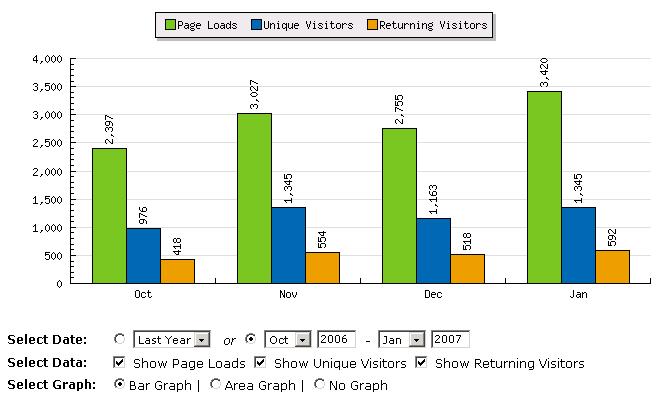
As an update on traffic to this site, according to http://www.statcounter.com/, we ended May with an average of 636 returning monthly users (see chart for monthly numbers January ’07 thru May ’07) out of an average 1,464 unique-monthly visitors. That’s up from the 2006 numbers of 400 returning monthly users and an average of 1,046 unique-monthly visitors.

As you can see, a lot of people come to this site each month, but I assume there are many more Explore the Bible teachers who are still unaware of the site. If and when it ever reaches 2,000 returning monthly users, then I guess it will have tipped. How many Explore the Bible teachers would you guess are out there?

It’s still confusing however that few of you ever leave a comment. It’s difficult for me to believe that fellow Bible teachers have nothing to say, or do not want to interact with other teachers. But you are proving me wrong!

I uploaded the first draft of my PowerPoint slides for Sunday’s lesson “Appropriate God’s Mercy”. The lesson over promises and under delivers somewhat, I think. More material is needed on repentance and the indwelling the Holy Spirit. Anyway, please let me know what changes you recommend to the slides. I’d appreciate it!

Thursday, May 31, 2007

Focus on repentance?

In his commentary on this week’s lesson, Dr. Sam Tullock mentions that Joel is quoted 39 times in the New Testament. Mark Rathel says the meaning of Joel—“Yahweh is God”—summarizes the message of the book. And her lesson commentary, Kathryn Aragon likens repentance—a change in thinking—to that of peeling thru the layers of an onion: both bring tears. Her commentary helps me understand one approach to this lesson is to focus on repentance. While it’s more comfortable to focus on God’s mercy, it may be more necessary to take up the issue of repentance.

Everyone is aware that peeling an onion can cause tears, but can that be used as an illustration to help members understand the nature of true repentance?

Wednesday, May 30, 2007

Before/after pictures

We are studying Joel 1:15-16, 2:12-13, 18, 25-32 this week in a lesson titled “Appropriate God’s Mercy”. Picking up on yesterday’s post, the fact that anyone survived such a plague of locust is a demonstration in itself of God’s mercy. Moreover, God sent Joel afterwards to explain to the people how to get right with God, which, I think, was an act of mercy.

By way of analogy, it is interesting to parallel our lives with those of Judah back then in a “before and after” picture. The before image is that of lives of plenty, full of pride, that are destroyed by some discipline from God, and the after portrait pictures people with contrite hearts.

Here is a question for you. If you think God warns us today, or disciplines us as He did the people of ancient Judah, do you think God will also send someone afterwards to help us get back on track with Him (as He sent Joel to the people of Judah)? Or do you think that our possession of the Bible and the indwelling Spirit today are sufficient? Do you have an example situation where a person that helped after a disaster was considered a godsend?

Tuesday, May 29, 2007

Appropriate God's Mercy

How do you plan to create interest in this week’s lesson, “Appropriate God’s Mercy”, which is based on Joel 1-3? A typical idea is to begin with an illustration of some disaster and ask if it can be interpreted as a warning from God. Joel’s prophesy was delivered on the heels of a plague of locust. He interpreted the locusts as a warning about impending judgment on the “Day of the Lord”.

In the past I’ve used Paul Revere’s ride as an example of a warning, and the hearers responded!But the major idea of this lesson seems to revolve around knowing that God is merciful. Maybe we should begin the lesson with an illustration of mercy (everyone survived this crash)? Why?

Friday, May 25, 2007

Presentation slides

Ninety five (95) of you downloaded the PPT slides from last week's lesson. I didn't put together slides for this week's lesson "Maximum Effort is Required", but Dennis McCallum from Xenos offers these slides on 2 Peter 3 that may be helpful.

Wednesday, May 23, 2007

"I'll be right back"

Regarding the issue of how God accounts for time, the LifeWay commentary notes on page 134 that “We are simply not in a position to make a judgment on this matter.” This reminded me of Rick Warren’s statement, “It’s like trying to explain the Internet to ants. They can’t understand it.”

After reading 2 Peter 3:8-10, for the lesson “Maximum effort is required”, I thought of several ideas for illustrations.

1. Suppose you are in a meeting room with a few peers and your waiting on the boss to attend the meeting, but he is late. Would you wait for him/her? Some peers may want to leave the room, but because you understand your boss as a person, you might say, “He’s coming, let’s be patient.” Likewise, Jesus is coming again. You encourage the others to be patient.

2. Suppose you and a few other acquaintances are waiting for a friend of yours to meet for dinner at a restaurant. Well after the expected arrival time, he/she is still a “no show.” Everyone else is hungry and wants to go on in and eat. You decide to be patient and wait since you know your friend. You are in a position to make a better judgment than one of the others with you, for example, who doesn’t know your friend. That person might say, “I guess they're not coming.” He/she loses patience and argues to go on in and eat. People that don't know Christ will claim that he is not coming.

3. Lastly, you’re walking your dog in the park, and you need to go inside the pavilion for a minute, but your dog is not allowed to enter (he is a dog). You tell him “I’ll be right back,” but he still gets frantic as you attempt to walk away. You go on in anyway and then return to find that your dog is nowhere in sight! He was not capable of understanding that you’d come back soon. It would be like an ant trying to understand the Internet.

Tuesday, May 22, 2007

Anticipation

The lesson “Maximum Effort is Required” from 2 Peter 3 is concerned with how our anticipation of Christ’s return affects our daily living. One way to illustrate anticipation is to take a new bottle of Heinz ketchup with you to class. As you start your lesson, open the bottle cap and hold it upside down as you talk. Believe me, it will take a good while before it comes rolling out! Everyone will watch in anticipation.

As another way to model “anticipation” and its affect on living, modify this anticipation/reaction guide to fit this lesson and have members complete it before and after the lesson.

For example, fill in the guide with seven (7) statements (see below). Members will write an A or D indicating they agree/disagree beside each statement before you teach. Teach the lesson, and then have members respond again (A/D). If the seven statements are intriguing, members will listen and react to your lesson in anticipation of hearing your answer to each of the seven statements. That is, they will “live in anticipation”, which models how Christians should live in view of the imminent return of Christ.

Seven sample statements (or make up your own):

1. The “last days” Peter mentions refers to the final days in the tribulation period leading up to Christ’s return
2. The Bible teaches two different “Second Comings” of Christ (1 Thes 4, Matt 24)
3. Relying on the truth of “all things continue as they have since the beginning”, uniformitarians argue that the present is the key to past
4. The Genesis flood is an example of God’ intervention in human history
5. You didn’t want me to make up all seven did you?
6. You add your statement here
7. and here!

Monday, May 21, 2007

Maximum Effort is Required

Key concepts for illustrations came to mind as I read thru 2 Peter 3 regarding this week’s lesson, “Maximum Effort is Required”. This included how to illustrate a promise kept and slowness.

Here is a news story about a promise kept that might be useful. For the idea of “slowness” (verse 9), I thought about coupling that with verse 8 by using a video containing both slow motion and fast forward footage to illustrate how a day is like 1000 years, or a 1000 years is like a day.

Watching footage in slow motion can be very boring, but it does illustrate how we tend to lose interest in watching for the return of Christ.

Friday, May 18, 2007

PPT slides for 2 Peter 2

In lesson preparation, the moment of truth for me comes when I try to write my outline, or write the final bullet points on my PowerPoint slides. That’s when I knuckle down and try to get it right. My class members will read it, or hear it, and it must be true to the meaning of Scripture as the Spirit intended. Based on prayer for God’s guidance and my simple understanding, please accept my PowerPoint slides for this week’s lesson “Spiritual Error is Rampant.”

Please note, I struggle with how deep to dive into phrases like “who bought them” in 2 Peter 2:1. If it's only briefly mentioned, I neglect an opportunity to explore more deeply what Peter possibly meant. Moreover, I can only teach what I know, but I don’t want to confuse people, or take the lesson down a ‘rabbit trail’, so I made some slide notes to help explain my thinking.

The last thing any of us wants to do is to make errors on this lesson! So please comment if you feel like I'm missing a key point! Thanks in advance!

Thursday, May 17, 2007

Sifting flour, spam blocking, and plastic

As I made homemade biscuits this morning I thought about the lesson “Spiritual Error is Rampant”, which is based on 2 Peter 2:1-22. I recalled decades ago my mother had to sift the flour when she made biscuits. This removed debris as well as an occasional bug that could be found in flour back in the 50’s. It reminded me that we have to sift the words we hear from Bible teachers, or material we read on the web to make sure it is free from error.

A more modern idea came to mind reading 2 Peter 2:18, where Peter mentions that false teachers lure, or bait people, like fishing, as they appeal to lustful desires and sinful human nature. Today, email spammers “phish” by making an appeal to the same lustful desires and sinful nature. We use spam blockers to arrest such messages before they reach us. In the same way, we must filter Bible teaching and preaching to eliminate erroneous material.

One more idea comes from verse 3, where Peter used the adjective plastos, from which we get our word plastic, to describe the words used by false teachers. Their words are molded like plastic to sound good, but they are deceptive and false. This reminds me of products that are made of plastic and look good, but they don’t last. They eventually are unsatisfying. Can you think of examples of where plastic is used today that really creates a deception? For example, a car bumper made of plastic looks good, but it doesn’t offer any real protection.

Wednesday, May 16, 2007

Misdirection

Spiritual Error is Rampant” is the lesson title this week, but so is the presence of false teachers. As teachers our goal this week is to (1) help members identify the characteristics of spiritual error, (2) denounce it and (3) uphold the truth.

Writing for Watchman Fellowship Expositor, James Barker identifies Heresies: Then and Now, which is worth reading.

As a former football player, I remember the value of misdirection plays, like the wingback counter (see diagram). The play was very successful against a defense that over pursued. A false teacher successfully uses misdirection to get his overly eager followers to take their eye off the ball (the gospel of Jesus Christ).

Tuesday, May 15, 2007

Example false teachings today

As we study 2 Peter 2:1-22 this week and the lesson “Spiritual Error is Rampant”, we need to identify examples of spiritual errors today. But Peter addressed teachings that damaged the gospel, not just flawed interpretations of particular passages. How about the question of “Who is Jesus Christ?”—(See the conclusion of the article).

What examples can you cite?

Monday, May 14, 2007

Spiritual Error is Rampant

This week we are studying 2 Peter 2:1-22, which makes clear that Spiritual error is rampant. Google the phrase, “Toronto Blessing” and you’ll see a number of example videos posted where people imitate animals and sound out animal noises supposedly as part of a worship service. Adult members may be shocked to see such goofball antics, but it represents just the tip of the iceberg of false teaching in the church today.

Thursday, May 10, 2007

The past (God's Word) is the key to today

While on a Grand Canyon trip last year, I heard Dr. Andrew Snelling deliver a message based on 2 Peter. As a geologist, he described a basic uniformitarian mantra “The present is the key to the past.” He made the point that when people deliberately forget God’s word, it’s a spiritual issue, not a scientific issue.

As I read 2 Peter 1:12-21, verse 19 tells me that the key to today is the past! That is, God’s word written so long ago is a trustworthy source of light today. We only have to read the Word to understand the times we are living in.

You might consider using a flashlight as an object lesson at this point and liken it to God’s word. You’d have to turn off the lights in the room, and use the flashlight to illustrate how it can illuminate a dark place.

Tuesday, May 08, 2007

Sticky notes

This week we are studying 2 Peter 1:12-21, where we are reminded that “God’s Word is Essential”.

Post-it-Notes are a top selling office product used to help remind people of things they need to remember. At the beginning of the lesson, pass out sticky notes to members in your class while telling the story of how sticky notes were invented.

An objective of this lesson is to get members to remember to study God’s word each day. They can write Post-It-Notes during the lesson to help them remember to do this and place them as reminders at home, in their cars, and at work!

Sunday, May 06, 2007

Slides for "Growth is Intentional"

I failed to post my PPT slides before teaching "Growth is Intentional" from 2 Peter 1, but I think some of you will still find them useful, so click here to download them.

Friday, May 04, 2007

Fertilize for growth

Spiritual “Growth is intentional” and so you need some fertilizer. Right? According to these PPT slides by Mark Hatfield, the ideal “Savior’s Fertilizer” is found in 2 Peter 1:1-11.

Thursday, May 03, 2007

Up the Down Escalator

While studying our lesson “Growth is Intentional”, I read about the need for balance in our lives between legalism and complacency (see footnotes 1 and 9).

As teachers we must guard against false teaching and depend on the Holy Spirit to guide our class members and us into the truth. Has the Spirit lead you to understand Peter’s main point in 1 Peter 1:1-11?

The “Therefore” in verse 10 makes it key. Christians can be sure, or confident in their salvation. God has given us everything (v. 3) to escape corruption so that we won’t fall away and regress in our faith, for example, like believers did in Hebrews 5:11-13. Rather than digress and fall victim to false teaching we can grow more Christ-like by consistently applying Bible teaching about Jesus Christ to our lives.

To me, living in the world is somewhat akin to walking up a down escalator. The Spirit leads us to move upward in maturity, but the world forces us down if we cease to consistently apply Godly teaching in our lives. If we stop growing, the world will put us right back where we started (in terms of Christian maturity).


If you don't like the idea of walking up a down escalator, consider instead the idea of walking uphill to summit a mountain peak as illustrated in the photo.

Wednesday, May 02, 2007

Lucky, or what?

We are learning this week that “Growth is Intentional” from 2 Peter 1:1-11. Peter mentions perseverance in verse 6, which brings to mind the adage that “practice makes perfect”, not luck.

I remember an offensive drill that ball carriers practiced to help them learn not to fumble. A running back ran with the football on a narrow path between two lines of defenders who forearmed, shoved, and otherwise tried to force him to give up the ball. He would enter the shoot on one end and the defenders would knock him around as he made his way to the other end, hopefully still carrying the football.

Like a running back that learns to hold on to the ball in trying times, a Christian perseveres in the faith during life’s trials. We learn to do this by practicing the dicipline of prayer, living in personal relationship with Jesus Christ, and regular fellowship with other Christians.

This article discusses the role of “luck” verses “hard work and determination” in the success of a basketball team. From a Christian perspective, there is no such thing as luck because the Bible teaches that God is in control.

Tuesday, May 01, 2007

Accountability

Regarding this week’s lesson: “Growth is Intentional”, hard and fast accountability is key to successfully completing one’s responsibilities (see “accountable measures” in point 6 of this article). Lack of accountability permits lack of follow through on our commitments. For example, read the paragraph that mentions, “follow through” in this story about Washington Mayor Fenty. Notice the complaint that he loses interest in projects (and doesn’t dig into details). Those closest to him chose not to hold him accountable.

What means of accountability have you established for yourself in order to help you keep your spiritual commitments? For example, members could use their Bible study attendance record as an accountability measure, or some accountability questionnaire. Progressive members can try using accountability buddy.

Monday, April 30, 2007

Intentional growth

A believer's spiritual growth must be intentional, it won’t happen automatically, or even stay in stasis. This first lesson: “Growth is intentional” from 2 Peter 1:1-11 teaches us to take responsibility for our own spiritual growth. Are you one to make excuses? Or do you like to blame others? Taking responsibility requires that we do neither of these.

One time when I wanted to coast for a while an old coach said to me, “You’re ether growing or dying!” He was right. Jesus said, “Whoever has will be given more, and whoever does not have, even what he has will be taken away.” Believers are given understanding of the gospel, but they must make every effort to grow spiritually. Do you take responsibility for your spiritual growth or do you make excuses?

The question I have is this: why are we apathetic about growing in spiritual maturity? Do we not understand the benefit? Are we satisfied only with salvation and ignorant of a great inheritance? Are we conditioned to take only what comes easy and discard that which requires effort? Why do we spoil by inaction a better life?

I’m just starting to study this lesson, and praying that God will teach me what needs to said this Sunday. I hope you are excited about studying 2 Peter, too!

Friday, April 27, 2007

Humbling experience

Commenting on “Act with Humility”, Dr. Sam Tullock wondered why Peter included the phrase: “a witness of the sufferings of Christ”. He speculates that Peter recalled his own human weakness and the “circumstances of his greatest failure.” After emphatically declaring he would rather die first, Peter denied knowing Christ three times before the cock crowed just as Jesus predicted.

How humiliating that must have been for Peter. It’s said that others taunted him by whispering, “cock-a-doodle-do” as he passed by.

Hearing this mocking makes me weep at the thought of my own failures, but I thank God for a loving Savior—Jesus Christ.

Thursday, April 26, 2007

Firm up

Step 4 of “Act with Humility” is based on 1 Peter 5:8-14. These verses highlight a promise of what God will do to help suffering believers. My summary is that he will firmly equip believers, give them a firm resolve, put them on a firm foundation, and stiffen them spiritually for whatever persecution lays ahead. The words firm and stiffen stand out.

Hairspray comes to mind as a possible tool to illustrate this. Gusty wind persecutes the best coiffure. Using hairspray, both women and guys (now days) firm and stiffen their hair before venturing outside (where windy torments abound). Help me out here. Is this an idea with any merit?

Tuesday, April 24, 2007

The way to humility

Alfred Ellis offered twelve ways to humility, which I can no longer find on the web. Below is a copy I made about two years ago. Many people asked for copies of this slide after I presented it. Taking these steps will help us “Act with Humility”.

1. Routinely confess your sin to God. (Luke 18:9-14)
2. Acknowledge your sin to others. (James 3:2, James 5:16)
3. Take wrong patiently. (1 Peter 3:8-17)
4. Actively submit to authority…the good and the bad! (1 Peter 2:18)
5. Receive correction and feedback from others graciously. (Proverbs 10:17, 12:1)
6. Accept a lowly place. (Proverbs 25:6,7)
7. Purposely associate with people of lower state than you. (Luke 7:36-39)
8. Choose to serve others. (Philippians 1:1, 2 Corinthians 4:5, Matthew 23:11)
9. Be quick to forgive. (Matthew 18: 21-35)
10. Cultivate a grateful heart. (1 Thessalonians 5:18)
11. Purpose to speak well of others. (Ephesians 4:31-32)
12. Treat pride as a condition that always necessitates embracing the cross. (Luke 9:23)

Monday, April 23, 2007

Act With Humility

This week is the last lesson from 1 Peter, entitled “Act with Humility”, and it’s based on 1 Peter 5:1-14. A past lesson “avoid arrogance” (opposite of humility) with PPT slides may give you some alternate ideas for teaching this week. Another past lesson from Hampton Road Baptist Church teaching us to “Consider Others” (with PPT slides that I used) may also be helpful in your preparations this week.

Also, here are some past blog entries, which mention “humility”, or “consider others”. These verses from 1 Peter also present an opportunity to discuss Baptist church polity, but that may take the lesson in a different direction.

Friday, April 20, 2007

Stay Focused ... PPT Slides

Click here to download the PPT slides I plan to use Sunday.

I won't have time tomorrow to update them, but if you have an idea to improve the presentation, please post it!

Thanks!

Thursday, April 19, 2007

The end is in sight

It’s hard to keep going. You’re tired, discouraged, almost overwhelmed, but the “end is in sight”, so you persevere living as a Christain. You operate in the Lord’s strength and live according to His will for His glory. This is what I understand 1 Peter 4:7-11 to say.

You might share insights learned by “keeping on, keeping on” to reenforce the idea that we grow by learning to persevere.

Wednesday, April 18, 2007

Grow in maturity

Several of the commentaries on this week’s lesson mention the idea of ‘urgency’ due to Peter’s opening remark: “The end of all things is near.” This lesson can help us grow in maturity, which we urgently need to do. Why? The maturity we enter heaven with is all we will ever have, and Christ’s return is near, so we need to get busy growing.

Yesterday I mentioned Kathryn Aragon’s Suffering Quotient Quiz, which she proposed as a means of demonstrating how we react, not how we should respond. I think I’ll use it immediately after I set the context for God’s purposes for us.

To learn to respond maturely in stressing situations, we should discipline ourselves to think before we act and feel (TAF). A friend once taught me not to feel, act, and think (FAT). That’s a reaction. Here is a page discussing TAF, but it is not written from a Christian perspective.

Tuesday, April 17, 2007

Suffering Quotient

Staying focused is another element of this week’s lesson “Stay Focused on God’s Purposes” that demands some context. If you Google search “How to stay focused” you get pages of recommendations on how to stay focused at work, at school, etc, but an article written in the 1600’s tells how to spend a day with God. I like its message on our ultimate purpose (1 Corinthians 10:31), which coincides nicely with 1 Peter 4:16.

I also like Kathryn Aragon’s quiz to measure our “Suffering Quotient”. And her message on how we should respond verses react is important, too. It fits with James’ admonition for Christians to operate in wisdom from above.

Monday, April 16, 2007

Stay Focused on God's Purpose

The lesson title this week “Stay Focused on God’s Purposes” begs that we set a context of “God’s Purposes,” which needs to be narrowed down to what's relevant for this lesson. You might consider asking members to identify God’s purposes in 1 Peter 4:7-19 as you read the background passage. Have an assistant list these on a marker board as they are called out.

Richard Dodge, writing in the LifeWay Extra, offers a suggestion to open the lesson with a discussion of the meaning of “fan” which leads to the idea of “fanaticism”, but I don’t know if this is a good thing since Peter the apostle suggested that Christians should be zealots in doing good (1 Peter 3:13).

Friday, April 13, 2007

Resolve

1 Peter 4:6 presents another difficult verse to interpret. I like the insight given by Dr. Grant C. Richison, of Campus Crusade for Christ and former Baptist pastor. His reference to Peter’s focus on the “historic past” makes sense. His underlying principle “Christians face an altogether different future than the lost” should strengthen a believer’s resolve, especially one in the midst of persecution for Christ’s sake. Even though they lost the game, this coach is happy with the team’s resolve. Makes me wonder if Christ is happy with my resolve.

Thursday, April 12, 2007

Confusion

Tim West, pastor of Hornsby Baptist Church, Hornsby, TN, suggests an interpretation of 1 Peter 3:19-20 that “presents some extreme difficulties” according to the LifeWay Adult Commentary (p. 77). Mark Rathel, professor of theology at The Baptist College of Florida, carefully dissects the passage to conclude that Jesus did not descend into Hell.

1 Peter 3:21 can also be misunderstood to imply that baptism is a sacrament. However, baptism is representative, or symbolic and is a pledge of obedience following repentance and confession of Jesus as Lord. Salvation is by the grace of God through faith, a gift from above.

How do you plan to present these difficult to interpret passages in your class so as to avoid confusion?

Wednesday, April 11, 2007

What hope do you have?

LifeWay’s Adult Extra, by Richard Dodge, for this week’s lesson “Prepare for Suffering” highlights how people take offence by statements that are politically incorrect by today’s standards. He indicates how Jews were possibly offended by the gospel in Peter’s day, which led to Christian persecution and suffering.

How do you react to stories like Christians are losing America? With what hope can we encourage each other? How is Christian hope different from wishful thinking?

Tuesday, April 10, 2007

Measuring device

I like David Self’s sports preparation analogy in his commentary on this week’s lesson, “Prepare for Suffering”. No matter what our endeavor is, we prepare in advance for what eventualities may come. Christians are taught that they will suffer for Christ’s sake (eg. 2 Tim 3:12, 2 Cor 1:5, Rom 8:17, Phil 3:10), and Kathryn Aragon does a good job of helping us understand how to prepare.

Reading her comments makes me think of displaying a variety of measuring devices (say a ruler, a balance scale, a weight scale, etc.) and have members say which device is useful for what problem. Afterwards, ask how should we measure ourselves regarding our actions and our motivations, for example, are we people pleasers? Do we adhere to God’s Word? Do we apply wisdom of the world, or the wisdom of God? Consider a recent incident in your life and your response. What measuring device did you use?

Monday, April 09, 2007

Prepare for Suffering

Bayleaf Baptist in Raleigh, NC posted a bit of LifeWay material for this week’s lesson “Prepare for Suffering”. On cursory analysis, we prepare for suffering using the same strategy we’d use to prepare for any coming difficulty. For example, a bear prepares for winter by storing body fat in the fall. From a spiritual perspective, what reserve does a Christian strengthen, or store believing that persecution is sure to come?

The short answers are to prepare by assimilating God’s Word, establishing Christian friendships, and maintaining a close walk with Jesus Christ. All of these will contribute to sustaining faith when difficult times come. A handout similar to this one might be a helpful tool for this lesson. Members could complete it as you teach.

Sonshine posted an in-depth set of study questions for this lesson, and Manchester Baptist Church, Manchester, MO, posted the shorter list below:

About what should Christians be passionate? (3:13)
For what might others ask Christians to give a defense? (3:15b)
Where is Jesus now? (3:22)
How should believers live the rest of their lives? (4:2)

In a sense, we are always preparing for some eventuality. How are you preparing to teach this week’s lesson? Do you rehearse your lesson presentation?

Thursday, April 05, 2007

Interesting visuals

I’ve been looking for interesting (and accurate) PPT slides concerning Luke 24 that you could incorporate into your lesson. Slides from Barry Chant give an Easter account with some interesting visuals.

Tuesday, April 03, 2007

Share New Life

Well, last Sunday my class responded exceptionally well to the lesson, “Exercise Submission’s Power”. Also, there were 65 downloads of the PPT slides posted on this site, which I hope you found useful.

This coming Sunday we will not have Bible Study given the size of our congregation. With only two Easter services on Sunday morning, the parking lot can’t hold all the cars that would be needed if people attended one worship service then stayed for Bible Study while another group attended the other worship service.

Given that I won’t blog about the lesson, “Share New Life” except to note various helps posted on the web, such as the study questions posted by Cornerstone Baptist in Arlington. Manchester Baptist Church, Manchester, MO., posted more study questions.

Here are some notes on the lesson posted by the pastor of Pickles Gap Church of Conway, AR.

I’ll keep looking!

Happy Easter!

Saturday, March 31, 2007

PPT Slides for Exercise Submission's Power

Around 50 to 75 of you regularly download PPT lesson slides when I post them. I hope they are useful to you. If you have suggestions for how I can improve future slides, please let me know.

Here is a link to this week's lesson: Exercise Submission's Power. I put notes on most of the slides as a help :-).

May God bless you as you prepare!

Wednesday, March 28, 2007

Tall order

Based on 1 Peter 3:7, Step 3 of “Exercise Submissions Power” shifts to consider the husband’s responsibility. He should submit “in the same way” as demonstrated by Christ’s example (Mark 14:36, 1 Peter 2:21). Moreover, a husband should live understandingly with his wife, admiring and respecting her. That’s a tall order!

Is there a universal symbol for submission? Umbrella? A white flag? Throw in the towel?

Tuesday, March 27, 2007

Power to Convince

Are you going to include a discussion of Ephesians 5:22 when you cover Step 2 of this week’s lesson, “Exercise Submission's Power”? In 1 Peter 3:1-6, Peter suggests that submission may lead to the conversion of a non-believing husband. On the other hand, Paul is more theological and cites God’s plan—Christ is head of the church and the wife submits to the husband as the church submits to Christ. He goes into more detail in 1 Corinthians 11:2-15.

If you stick close to Peter, then the idea of a wife beautifying herself with a “Hidden Heart” beauty product is a possible illustration. It’s the brand and the jar it comes in is called Submission. My homemade picture may help clarify the idea.


Lastly, I want to call your attention to 1 Peter 3:6 where it says, “do not give way to fear.” The LifeWay Leader Guide (p. 57) gives one explanation for what Peter meant. Another possible explanation, which I’ve heard, relates to the idea of a wife’s actions motivated by fear of not being in control of her husband. That is, naturally her tendency is to control, or dominate her husband, and submission means forfeiting that control, which causes fear. Peter commands wives not to give in to that fear.

Monday, March 26, 2007

Exercise Submission's Power

This week we are studying 1 Peter 3:1-12 in a lesson titled “Exercise Submission’s Power”. The title implies that there is power in submission. The question is: Can the practice of submission further God’s kingdom?

Here is an interesting script presenting accusations made against early Christians, the type of which might have prompted Peter’s letter. It paints a picture that indicates Christians were misunderstood.

Tim King gives his opinion as to why the world hates Christians today (as he endeavors to clarify Jesus’s teaching in John 15—“the world will hate you”). Read the text or watch the video, but be warned, his assertions are terse. Also, without any rebuttal, he leaves you with the impression that hatred of Christians today is justified.

In this lesson, I don’t want to stray too far from Peter’s context of persecution and suffering. To grab member’s attention at the start, I’m thinking of beginning the lesson by reading 1 Peter 2:12 and 1 Peter 4:4, highlighting “accuse you” and “heap abuse on you.”

Next, I’d present what the world said about Christians in the past followed by what the world hates about Christians today (the two links above offer some help to support this).

With this opening plan, I can easily fold in a summary of last week’s lesson regarding submission to government authority and employers after the opening.

Friday, March 23, 2007

Some ideas

For passages like this week’s 1 Peter 2:13-25, it might be best to let the Word speak for itself. For example, work with members to do a word study on “submit” and its various forms of usage in the New Testament. Other words to focus on include the following:

Vs 13: “every authority”—Am I selective about which authority I demonstrate submission? Name the easy ones. Name the hard ones. What makes the hard ones, hard?

Vs 15: “ignorant talk”—possibly a reference back to “accuse you” in verse 12, or maybe it looks forward in 4:4b, which says “heap abuse on you”?

Vs 16: “free men”—We emphasize individual liberty in the USA. How does our focus on freedom conflict with God’s desire for us take part in a Christian fellowship? Technology advances allow us a strong measure of independence (little requirement to participate in fellowship), but is that in keeping with God’s will for us? How does our drive to be financially independent, healthy, comfortable, and entertained interfere with God’s desire to growth us up in spiritual maturity to become like Christ?

Vs 17: “fear God”—You could spend the whole lesson time investigating reverencing God. We are free from a civil perspective, but spiritually we are either slaves to God, or slaves to sin. Which is it in your case?

Vs 18-23: “suffer”—count the number of times the word or one of its forms is used. Dwell on its meaning and relate it to modern life in the USA.

Vs 24: The key verse possibly? There are wrong applications of “by his wounds you have been healed”. Case out the alternatives for members, and help them understand what Peter actually says in the original context.

Vs 25: “but now”—Choose to live by faith, not fear. Believe God’s promise and place your trust in God to do what he says he will do.

Wednesday, March 21, 2007

Christian Submission--God's Plan

I’ve been very busy this week and haven’t had much time for posting. The lesson is “Practice Christian Submission” from 1 Peter 2:13-25. How can we convey the idea of Christian submission and the struggle that it usually entails? One idea is to mention Submission Wrestling, and show this short clip of a submission-wrestling match. We struggle to avoid submitting to God-ordained authority just like the two wrestlers struggle to not submit to one another. In what ways do you struggle against authority--in church, at work, in your home, or with government officials? In what ways is your experience like that of a submission wrestler?

Saturday, March 17, 2007

PPT Slides for Display a New Identity

I posted my PPT slides for tomorrows lesson: "Display a New Identity". Hopefully, they will be of help to someone. I also added slide notes to each slide as a help.

Thursday, March 15, 2007

People are drawn to…

1 Peter 2:1-12 contains a number of analogies including getting rid of old clothing (vs 1), for example, the hunger of “newborn infants” (vs 2), and “living stones” (vs 4). Verse 12 made me think yet another idea. People are drawn to a beautiful mountain and they praise God when they see it. Likewise, the good works of Christians draw others and they glorify God as a result.

Like a magnet draws iron filings, a bug zapper draws insects, and a honey pot draws bees, people are drawn to God. A waterfall, a funny picture, the ocean, and the unexpected are a few examples of other things that draw people. You might ask members to say what draws them?

Wednesday, March 14, 2007

Unfiltered ideas for illustrations

Reading 1 Peter 2:4-10 set me to thinking about a number of ideas for illustrations. For example, a person who is a clown is an ordinary individual until he/she puts on a clown’s clothing and paints on a clown’s face. At that point they display the identity of a clown by behaving as a clown.

The same goes for someone wearing a Santa Claus suit. You can probably think of many other examples, but the idea is simple. The question is this, however, what’s the difference in change of identity between an individual that becomes a clown and an individual that becomes a Christian?

There was a news article this week detailing why we do not make cheese from pig milk. Supposedly, cheese made from pig milk would have poor taste since it contains long-chain fatty acids, unlike cheese made from cow’s milk, which contains short-chain fatty acids. Taste matters obviously, and once a Christian has tasted pure spiritual milk, he has a desire for it—not some substitute!

I read about cornerstones, and it can be thought of as a stone that joins two walls together. A simple join doesn't sound too profound, but it suggests an interesting analogy. As The cornerstone, Jesus joins God with man. His Spirit makes believers alive unto God enabling Christians to grow in spiritual maturity. Any man (wall) that rejects Jesus, stumbles over Him and falls.

Tuesday, March 13, 2007

Purity Matters

To make the point that to grow spiritually Christians must desire to listen to sound preaching, watch the short video “Purity Matters”. The “unadulterated spirit milk” Peter spoke of in 1 Peter 2:1-3 is a reference to the quality or “purity” of the “spiritual milk” or Word Christians consume (from personal Bible study, teaching and preaching).

To grow, a Christian must have a strong desire to hear preaching, for example, that rightly divides the Word of truth. Preaching that only coddles what one wants to hear will not challenge the heart and mind to grow.

Take a couple of bottled waters to class and call a member to the front of the room. Make the offer for the member to choose a bottle to drink from, and then before the person responds open one of the bottles and drink from it. Then see which one the person chooses. Make the point that purity matters in what we listen to as Christians. Ask members if they likewise desire to listen to pure (quality) teaching/preaching of God’s Word.

Do you have other ideas for how to illustrate the importance of the concept of "purity" that's needed in order to grow spiritually?

Monday, March 12, 2007

Display a New Identify

This week’s lesson “Display a New Identity,” from 1 Peter 2:1-12, challenges Christians to develop and demonstrate their identity as Christian so that unbelievers will praise and glorify God.

For some reason the Beverly Hillbillies came to mind as I read the lesson today. The TV show was immensely popular. It features an extremely poor family, the Clampett’s who “barely kept the family fed”. They find extreme wealth (“up thru the ground came a bubbling crude”) and as very wealthy people, they move to Beverly Hills, California.

The show derived its humor from the fact that the Clampetts didn’t change their identity once they became wealthy. Many Christians are like this. They believe that Jesus is the Christ (become wealthy), but never accept responsibility for their new identity.

A real life example of achieving extreme wealth is the Sam Walton family, but I don’t know if the family altered their lifestyle in accordance with their identity as extremely wealthy people (5 of the top 10 wealthiest people in the world).

Perhaps you can think of other examples, but I was thinking of starting the lesson by showing a video clip of the Hillibillies (that would have everyone laughing). Then we could dive into the challenge of the lesson.

Sunday, March 11, 2007

Last minute help

Last evening at dinner an idea occurred to me for illustrating how we should be holy like our Father in heaven. Hold up a picture of a man and his son, or show a picture of a man along with a younger man. Ask members if the younger man is the son of the older man. Why? We know he a son because the younger man looks like his father. The same is true for a Christian made in the image of God being conformed to the likeness of His Son Jesus Christ.

Thursday, March 08, 2007

Wilting Flower

1 Peter 1:22-25 illustrates the old life in the flesh with a wilting, dying flower. A life lived in the flesh is that short.

Wednesday, March 07, 2007

Bob

I’ve been searching for a replacement commentary or lesson plan for the material previously generated by Hampton Road Baptist Church (see links on the right side of this page). Brother Bob’s plans were usually very good, but he has not posted in a number of months. If anyone knows why Bob ceased posting his lesson plan, please let us know.

Do you have any comments about Quarterly lesson ideas from Deacon Bob? I have yet to find an affiliation for this Bob.

Monday, March 05, 2007

Don't quit

Based on 1 Peter 1:13-25, this week’s lesson “Accept a Challenging Standard”, reminded me of the adage, “You get what you paid for.” Discuss with members if that statement is true or not these days. Christ paid with his life to redeem us. If the adage is true, how valuable does that make you? How well we measure up, that is the salvation of our souls, will be clear by the inheritance we receive. While it is challenging, don’t give up! “I quit” is just as bad as “I won’t” when it comes to living in agreement with God’s Word.

Sunday, March 04, 2007

Stranger illustration

This is a last minute post, but I thought I'd tell you that I plan to illustrate the idea of "strangers" mentioned in 1 Peter 1:1 using a man in a shopping mall with his arms folded (or you could show a woman at some sporting event with a non-participating attitude). Lot's of men don't like to shop, so the illustration underscores how Christians should not love the world since our real home is in heaven.

Friday, March 02, 2007

Thematic illustration?

A Biblical story of stolen identity is that of Jacob assuming the identity of his brother Esau in order to steal his birthright.

It seems this week as though I’ve been stuck on the issue of “identity”. Peter’s readers were persecuted because of their identity as Christians; they suffered as a result of their belief in Jesus Christ. When undergoing such suffering, assurance becomes paramount, which Peter emphasized. Furthermore, he reminded his readers of their coming reward, but emphasized their need to live holy lives.

So there is much more to the lesson, and frankly I’ve simply been trying to get my arms around the letter. Since our identity in Christ is backed by genuine faith, perhaps a thematic illustration emphasizing transformation is that of a true diamond versus synthetic cubic zirconia. Despite their similarities, one is a genuine diamond, and the other is not. It seems I’m back to that identity issue again. Oh, well.

Thursday, March 01, 2007

How many of me are there?

An interesting approach is to lookup your name using the site: http://www.howmanyofme.com/ as well as some of your class member’s names. Use the counts to underscore how insignificant we might be in this world, but remind members that the Lord will give each one of us a unique name in heaven. For example, there are 190 people in the U.S. that have my name—not very unique compared to my identity in heaven (Rev 2:17b)! You can tie this into the new birth Peter highlights in 1 Peter 1:3.

Wednesday, February 28, 2007

Confidence from a known identity

“Who am I?” is a fundamental question. Each of us has a need for identity. Peter speaks to this need right away to the letter’s recipients in 1 Peter 1:1-2. He identifies them as strangers in the world (citizens of heaven living on earth—Phil 3:20), chosen as God’s elect to confess Jesus Christ as Lord and believe in him.

How does knowing one’s identity build confidence? Identity is valuable. Underscore this by presenting information about identity theft.

Tuesday, February 27, 2007

Acknowledge a secure salvation

"Acknowledge a secure salvation," 1 Peter 1:1-12.

What makes you confident? Where does it come from? What’s it based on? What is a common characteristic in the answers to the following questions? This should help members get ready to answer the question "What makes you confident that you are a Christian?"

What makes you confident that you’ll succeed?

What makes you confident that you can afford such-n-such?

What makes you confident about the future?

What makes you confident about a certain medical procedure?

What makes you confident in so-n-so?

What makes you confident that you can meet that schedule?

What makes you confident in that theorem?

What makes you confident that will happen?

Friday, February 23, 2007

Deliverance celebrated

For Step 4 of “What’s Worth Celebrating," the lesson plan offered by Jeff Meyer, from Bayleaf Baptist Church, Raleigh, NC, may help?

What occasions do you celebrate? I’m thinking of Anniversaries, Births, Birthdays, Engagements, Coming Home, Graduations, Holidays, Promotions, Weddings and other Special Occasions. Have you ever planned and implemented a celebration focused on God’s deliverance?

Wednesday, February 21, 2007

Quick victory

For Step 3 of this week's lesson "What's Worth Celebrating", I like the suggestion found in LifeWay Extra, written by Becky Imhauser.

Tuesday, February 20, 2007

Finding the one person who can help

Esther courageously advocated a legal means to spare her people in Esther 8:3, 6-8, 11, which is the point of Step 2 in “What is Worth Celebrating”. The resulting decree provided a way for the Jewish people to be spared.

We are a “nation of laws.” Explore what that means with members. Xerxes was a king, who ruled by fiat. Esther interceded with the one person that could actually help her. In our society, is it possible to find just one person that can help? Take an example issue and brainstorm with members how they might identify the right person to contact for help.

Monday, February 19, 2007

What is Worth Celebrating

My template for preparing the lesson each week? Ha! It may be good, or it may be bad based on how you use it, but I thought it worthwhile to share it with you. Do you have such a system to help you prepare each week?

1. Concept slide—a picture or graphic projected while the class gathers and is meant to establish a key idea related to the lesson in the minds of class members. For example, last week I used a slide full of excuses typically used by people to avoid getting involved in a difficult or risky task.

2. Title Slide—for example, this week it’s What’s Worth Celebrating, Esther 8:1-10:3

3. Impact slide—a story, a video, or whatever that’s used to grab people’s interest
(optionally I follow this with a slide that makes the impact personal to members).

4. Key Bible Truths to be covered in the lesson—if a I have a picture on a slide, I like for it to tie to the concept slide (#1) in some way so that the opening idea is not lost. (Optionally, I follow this slide with a “pop quiz” relating specifically to the verses we cover.)

5. Who is the lesson for—usually I rephrase the material provided in the LifeWay Leader Guide, and add my own listener identities

6. An overview slide—if it’s the first lesson of a book, then this slide is an overview of the book. Otherwise, it’s a brief summary of what’s been covered up to this point.

7. Title from step 1, and verses—perhaps include a picture relating to the concept established in #1. I read the verses, then step thru key points, observations, and bible insight.

8. Application from step 1.

9. Repeat #7 and #8 for each step in the lesson.

10. Identify a key verse and put it on a slide. Say why it is key as it pertains to the lesson title. For example, last week I used Esther 4:16c as the key verse because in it Esther said, “I will go”, which I thought exemplified the triumph of her courage.

11. Apply bible truth—I rewrite the biblical truths for spiritual transformation provided in the LifeWay Adult Leader guide.

12. Closing slide—usually a call to action.

Saturday, February 17, 2007

Fasting

Concluding “How Courage Triumphs”, the verse exemplifying courage seems to be Esther 4:16b, “I and my maids will fast as you do. When this is done, I will go to the king, even though it is against the law. And if I perish, I perish.” Esther said, “I will go”, and she did.

But the verse raises the issue of fasting. Prayer is not mentioned in the book of Esther, but fasting is. What is the New Testament teaching on fasting? Are you prepared to discuss it if it's raised as a question in your class?

For those wanting a more complete lesson plan, try what's provided by Jeff Meyer from Bayleaf Baptist Church, Raleigh, NC.

Friday, February 16, 2007

Seeing justice done

Step 4 of “How Courage Triumphs” picks up with Esther 7:9-10, which records the king’s judgment on Haman. There are truly evil people in the world and one day they will be judged by a righteous King. Justice was recently served in the case of Saddam Hussein. Here are some other examples of seeing justice done in the UK. You got any better ideas?

Thursday, February 15, 2007

Exaggeration

Step 3 of “How Courage Triumphs” is based on Esther 7:1-6, and is titled by the LifeWay materials as State the Facts. Sgt Joe Friday on the popular Dragnet series frequently intoned, “All we want are the facts, Ma’am.” Refreshingly, that’s all Esther communicated to the king.

Thurman Seber makes the point that we should not “embellish our testimony”. Exaggeration is a first cousin to lying. Stick with the truth! Here is a story that cleverly comes to the defense of bats, which we are inclined to detest. I point it out only because it illustrates how exaggeration can lead to wrong conclusions. What are some example exaggerations you see in the headlines this week?

Wednesday, February 14, 2007

Stand out, Stand firm, Stand together, Stand against, Stand up

Step 2 of “How Courage Triumphs” is focused on Esther 5:1-3, which the LifeWay material titles, Step Out on Faith. These verses detail the action that followed Esther’s plan stated in 4:16. She acted in faith leaving the results to God.

Tonight at church, we prayed for a young man leaving shortly to serve in Iraq. His service in the United States Air Force illustrates to me similar courage and fortitude to that displayed by Esther. He trusts God whatever the outcome. As Paul described in Phil 1:27-30, this airman is standing courageously for Christ as he risks everything to serve his country in a foreign land.

Tuesday, February 13, 2007

Social loafing

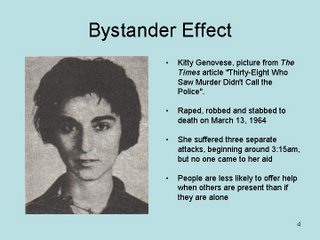
Reading about courage, I came across the story of Kitty Genovese, who was murdered and not one of 38 witnesses came to her aid. Would you have helped Kitty?

Below I posted pictures of the first few PPT slides I’ll use in my lesson on “How Courage Triumphs”. Do you know any social loafers? , For example, it is easy to coast in a community where there is no responsibility.

To motivate a solution requires that people first get to know one another. With the community using this site in mind, one solution alternative is to link to your personal websites off this site. If you post your personal website in a comment, I'll add it to such a list. I’d pray that the Lord makes it a long one!

Monday, February 12, 2007

How Courage Triumphs

When I first read the LifeWay material for the lesson “How Courage Triumphs,” it reminded me of Proverbs 26:27: “If a man digs a pit, he will fall into it; if a man rolls a stone, it will roll back on him.” Ironically, what Haman planned for Mordecai, happened to him. Politics aside we’ve recently witnessed the tables turned on press people as they are called as witnesses in a legal case.

Thursday, February 08, 2007

Shortcuts

Tabernacle Baptist Church in Cartersville, GA and First United Methodist Church in Newnan had at least three missionaries killed in a truck accident in Honduras this week.

These short-term missionaries were volunteers, Christians that risk a week or two away from home to make a difference for Christ in a foreign land.

Our pastor reminded us last night that there is no shortcut to the risk we take in living for Christ. The alternative is cowardice—a refusal to “chase after Jesus” in the race we run.

Here is a shortcut illustration. This post will cut short my blog this week due to unexpected travel and lack of Internet access. May God bless you as you prepare!

Wednesday, February 07, 2007

Working together?

Picking up on my post yesterday, to complete slide 4, the attention-grabbing opening, you could use the LifeWay Extra suggestion to select and present prayer requests of missionaries to illustrate how service is sometimes risky. If you did this, what would do to complete slide 5 on making it personal for members? Anyone want to take a stab at that? We could get sort of a group effort going here!

Tuesday, February 06, 2007

Fill in the blanks

To help this week, I thought I’d be risky and post PowerPoint “starter slides” for the lesson, “When Service is Risky”. You can download the slides and look thru them to see my initial suggestions for structuring the lesson based on the LifeWay material.

I left blanks on the slides where you can make specific entries as you prepare this week. If you want to post your suggestions here so that others can see your ideas for completing the slides, please do!

Monday, February 05, 2007

When Service is Risky

I regularly give an update on traffic to this site to demonstrate that many of you Explore the Bible teachers have a need for teaching ideas beyond what’s found in the good materials available from LifeWay. According to the chart, January ended with an upward trend in number of page loads (3,420), number of unique visitors (1,345) and number of returning visitors (592).

The last statistic is the one that encourages me most since an increase in returning visitors indicates greater numbers of visitors are finding the site helpful (else why come back?). However, the goal of this site, which has not been achieved (IMHO), is for teachers to inspire each other by sharing their illustrations, object lessons, or other teaching ideas in a positive way—sort of a virtual teachers meeting.

I’m not particularly interested in finding more Bible ‘commentary’ since I assume the LifeWay materials meet that need, or any number of other good sources. But if you have an idea of how to present your lesson that you’d like to share with lots of other teachers, please post it as a comment (or anywhere else on the web and then post a link to it here). Some of you have told me that posting is "risky service", but hey, it can't hurt, and it might help! Thanks!

This week we study “When Service is Risky”, based on Esther 3:1-4:17.

Saturday, February 03, 2007

This just in

A series of drawings that tell the story of Esther might interest you, or the movie Esther. I also uploaded my PPT slides for “When Life Turns Upside Down”. Hope these help someone!

Friday, February 02, 2007

Illustrating obedience

I don’t know what your thoughts are, but the key verse of the lesson “When Life Turns Upside Down” might be Esther 2:10. If Esther was anything, she was obedient. Why? She trusted Mordecai, so she did what he said.

I am thinking about illustrating obedience and the good that comes from it using an example of harnessing water power. Moving water (our will) flows along a channel (our listening/conforming to God’s commands) to operate (our taking action) a water wheel, for example. Following that, many good things happen. However, when water is out of it’s channel (our disobedient nature), destruction follows. What do you think?

Thursday, February 01, 2007

Here we go rafting again

Step 5 of When Life Turns Upside Down focuses on Esther 2:16-17,21-23, or making the most of an unexpected opportunity. Esther became a queen. Her uncle Mordecai becomes a hero when he uncovers a plot to assassinate king Xerxes. The Bible says the king “loved” Esther. So he made the most of an opportunity—to actually love the beautiful Esther and not simply possess her as a “trophy.”

Be Ready When Opportunity Knocks makes some excellent points on times when “opportunity comes knocking”. For example, do you routinely let others know of your willingness to help them?

We posted last December about responding, “when opportunity comes knocking.” I still like some of the ideas for response to opportunities in the white-water rafting article.

Wednesday, January 31, 2007

To what end?

The Explore the Bible Adult Leader Guide, p 107 suggests reading an article about King Xerxes from the Biblical Illustrator Winter 2006-07 issue as background for teaching Step 3 (Esther 2:8-10) of this week’s lesson “When Life Turns Upside Down”. He was rich and powerful but failed in his attempt to concur the Greeks in revenge for their defeat of his father. Moreover, he was hot tempered and easily influenced by wrong advice.

Providentially, God put Esther in a position to also influence Xerxes in order to preserve the Jewish people. Not as dramatic, but as a young married couple, we briefly moved to Mississippi. Our daughter had a puzzling medical condition that previous doctors (a dozen) were unable to solve. Her new pediatrician diagnosed the problem correctly after only one exam. We thanked God and instantly new why He had allowed us to move to Mississippi.

If you ask someone to share a story of when God acted providentially in his or her life, follow up with the question “To what end do you think the events were allowed to transpire?” Surely, they should lead us to trust God in the midst of our circumstances.

Tuesday, January 30, 2007

Good coming out of a bad situation

Step 2 of “When Life Turns Upside Down” in this week’s Explore the Bible lesson is titled Accept Unavoidable Changes, and is based on Esther 2:5-7. Esther’s sacred name, Hadassah means myrtle tree, which has a bloom that’s used to make perfume. I’m sure Esther brought the sweet fragrance of a God-pleasing response to the unexpected events that occurred in her life.

The story of The Little Grass Hut illustrates how good can come out of a bad situation.

Monday, January 29, 2007

When Life Turns Upside Down

This week begins a series of “Explore the Bible” lessons from Esther. First up is “When Life Turns Upside Down (Mark Rathel’s commentary)”, based on Esther 1:1-2:23. From my perspective, study how Esther responded when her time came to meet with King Xerxes (2:15)? Did she follow one of these Seven tips for surviving sudden change? As a case study, also consider how Mordecai responded: (1) when his uncle died? (2) when Esther was taken away?

Friday, January 26, 2007

A page for all

The Baptist Start Page has lots of helps for teaching Nehemiah.

Thursday, January 25, 2007

A handful for sure

Should Christians observe a day of rest each week? This article is spot on IMHO. Read it carefully to help you prepare to teach Step 4 of “Keeping Commitments”, which is based on Nehemiah 13:15-18.

This lesson is shaping up to be challenging because members will need to contrast New Testament teaching on tithing and observance of the Sabbath with that as taught in the Old Testament. Principle versus command, or how do you plan to treat the topic of tithing and Sabbath observance?

Wednesday, January 24, 2007

Cause and effect

If “Keeping Commitments” were not important there wouldn’t be so many new articles mentioning “lack of financial support”. Make a list of interesting, recent failures due to lack of support and use it to demonstrate the results of poor follow through by those who make commitments.

P.S. Also made me think of "running on empty" and "shoestring operations".

It occurred to me that the topic of "Should Christians tithe?" might come up as part of your lesson.

Tuesday, January 23, 2007

Cleaning house

Part of “Keeping Commitments” was to use the temple the way God intended. When Nehemiah returned he discovered the misuse of the temple. The obvious parallel is that Christians should not misuse the temple of the Lord today. It may be time for some personal ‘house cleaning’? See the house cleaning custom observed in Italy as an interesting illustration.

Monday, January 22, 2007

Keeping Commitments

My lesson yesterday worked out very well. Since the topic was 'issue' based, I decided in the end to approach it by asking members the question "What does the Bible say?" about valuing life. I opened the lesson with four scenarios requiring members to give their advice in each case. I followed each answer with a question, "What's the premise of your argument?". I must admit, this created some anxiety, but I received so many positive comments afterwards from members that I concluded the lesson was successful in getting members to think deeply about their positions regarding 'valuing life'. My lesson was followed by a seven minute presentation from the director of a local CareNet facility, and her talk was well received, too. I hope you had good success, too!

This week's lesson, "Keeping Commitments" concludes our study of Nehemiah. This video shows how "good intentions" may not be what they seem.

Saturday, January 20, 2007

Valuing Every Life

Here are my PowerPoint slides for Sunday's lesson, "Valuing Every Life".

Hope I'm not posting them too late to be of use to you!

Friday, January 19, 2007

Last year

I went back and read "Live in Respect" on this blog, which was last year's "sanctity of life" lesson . If you teach a class with older members you may want to consider using it.

Years ago I memorized Psalm 139 as a means to understand the fear of the Lord and to meditate on the nature of God. We respect the Lord when we live obediently, and aware of God's presence at all times.

One idea I've had for teaching this lesson is to use a Q&A method that tests how well members are able to interpret and apply Scripture in a moral argument against abortion, euthanasia, embryo stem-cell research, etc. For example, consider the Scriptures cited in support of these Texas SBC resolutions. Are the Scriptures being interpreted according to good hermeneutical principles? The idea is to challenge members to rightly interpret the Bible's teaching regarding the sanctity of life.

Wednesday, January 17, 2007

God accompanied Noah

Step 3 of “Valuing Every Life” continues application of Psalm 139 to the issue of the value God places on each life. You might consider using the Truth video in your class.

An inspiring story to share with members is that of baby Noah, an embryo rescued from Katrina flooded New Orleans. Wow! He can always tell of how God providentially cared for him. Here is another account of Noah’s birth.

Tuesday, January 16, 2007

Dumbfounded

Step 2 of “Valuing Every Life” focuses on God and His knowledge of each of us as revealed in Psalm 139. I watched the National Geographic film Multiples this past Sunday and the video of what goes on in the womb is amazing. It made clear to me how a child in the womb feels, sees, and hears. Interestingly, in twins, for example, one twin becomes aware of and knows the other twin long before they are born.

Films from Sermonspice based on Psalm 139 might be useful to you in preparing Sunday’s lesson.

I don’t know about you, but I'm struggling to prepare for this lesson since I don't know what I can teach that everyone doesn't already know--the national tragedy of aborting 45 million children since 1973 is incomprehensible.

Monday, January 15, 2007

Valuing Every Life

This Sunday is a special lesson entitled “Valuing Every Life” that corresponds to “Sanctity of Life” Sunday. This resource kit might be useful to you.

May God have mercy on us.

Saturday, January 13, 2007

Good idea!

Ron Moore of First Baptist, Clarksville, TN is doing a daily email devotion Monday through Friday of each week. According to Ron, they are short, easy to read, and have a challenge for each day.

The devotions are related to the Explore the Bible Sunday School materials, using the same scriptures as in the lesson. If you are interested in getting the devotions link to “first things first”.

Friday, January 12, 2007

Taken seriously

When we blurt out, “I mean what I’m saying!” we do so in sincerity if we want to be taken seriously. When we say something like, “Can I talk to you about a matter that’s on my mind?” we do so in sincerity if we want the other person’s undivided attention. Can you think of other situations where you want your sincerity to be clear? For example, when you write a business letter, you end it with “Sincerely,”.

In Step 4 of “Rededicating Lives”, the Israelites wanted to indicate the sincerity of their recommitment to God, so they made an agreement and on which they placed their personal seals. Read Nehemiah 9:38, and 10:28-29. What do you do to indicate that you mean business with God?

Google, or Yahoo! “Service Agreements” and you’ll see lots of examples that underscore business relationships in today’s world. Here is a list of general components in a service agreement. Thought question: Would you be willing to complete and sign a service agreement with God?

Wednesday, January 10, 2007

Confession

Step 3 of “Rededicating Lives” comes from Nehemiah 9:1-2, which describes how the people repented publicly because of their encounter with God when his word was read aloud by Ezra. Essentially, their confession was a public demonstration of their collective private experience where they agreed with God about their sinful condition.

Zacchaeus offers a good example of public confession in the New Testament (Luke 19:7-9). If you need help capturing the video for playback in class, let me know.

How do you plan to illustrate repentance and public confession on Sunday?

Tuesday, January 09, 2007

Relationship vs Faith

In “Rededicating Lives” from Nehemiah 8:1,5-6,9-10, Step 2 highlights a change in the Israelite’s form of worship from that of only making ritual sacrifices to that of also reading of God’s word publicly.

This triggers a question. As you practice your Christian faith, which is more central to obedience: a focus on your personal relationship with Jesus Christ or regularly reading the Bible?

Obviously, both are critical, but I wonder if we don’t sometimes put our focus on ‘personal relationship’ and neglect Scripture?

What is the role of reading Scripture in practicing your faith?

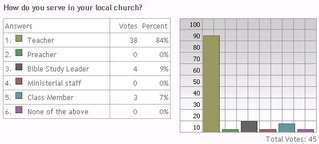
P.S. The results of last week's poll indicate that most of those who visit this site are teachers. Thanks for participating! Management

Monday, January 08, 2007

Rededicating Lives, Nehemiah 8:1-10:39

This week’s lesson “Rededicating Lives” is timely because we all fail and need to be reminded to confess our sin and recommit personally to God’s service. When a Christian sins, fellowship with the Lord is damaged even though the guilt of personal sin is eliminated through the work of Jesus Christ on the cross. As background for this lesson read Nehemiah 8:1-10:39.

A Christian friend of mine likens the Church in America today as “one giant baby nursery”. “Christians are simply refusing to grow up and mature in Christ,’ he claims. Ask class members to think critically about my friend’s statement. Have them explain why they would agree or disagree with his assertion.

P.S. I'll remove our poll tonight (see right side of page) and report the results tomorrow, so if you have not participated then today is your last chance!

Saturday, January 06, 2007

Manipulation today

Step 5 of “Devising Strategies” is based on Nehemiah 6:11-13. Nehemiah recognizes an attempt to ruin his good name. He wants to obey the Law and not sin (fears God) rather than run and hide.

I didn’t know the speculation that Nehemiah was a eunuch? Did you?

Are you beyond being manipulated today? Explain. How is your credibility as a teacher put on the line Sunday after Sunday?

Friday, January 05, 2007

Know thy enemy

Taken from Nehemiah 6:2-3, Step 4 of “Devising Strategies” illustrates how evil adapts its tactics in an attempt to thwart God’s purposes. However, Nehemiah didn’t negotiate with it (evil). Instead, he demonstrated he knew and understood his enemy very well.

How well do you know your enemy? Are you easily distracted by it (evil), or do you recognize it for what it is and refuse to fall prey to its tactics?

Have members name common distracters in their lives. Email? Phone? Radio? TV? How do these divert them from doing what they set out to do? Watch this video to see how even a baby can be distracted.

Thursday, January 04, 2007

Devising defensive strategies

How do you respond to intimidation? Do you take steps to enhance your security (Neh. 4:12-13, 19-20, 22)? How do you prevent an intimidator from controlling you based on your responses?

The Lifeway Explore the Bible material offers an example of winning a game by a good defense (p.67). In football, for example, both teams constantly adjust their game tactics in response to each other’s actions. Both teams have the goal to win the game.

Computer security requires an adaptive defensive strategy against virus software.

How do you plan to illustrate Step 3 in this week’s lesson “Devising Strategies” ?