Friday, February 10, 2006

Explosion of hope

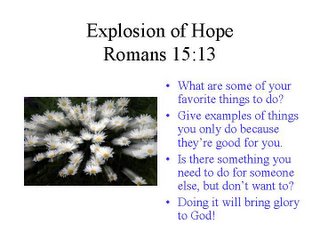
Romans 15:13 is the basis for Step 5 of the lesson “Glorify God”, which is summarized in the LifeWay Leader Guide as “Expressing Hope”. Paul prays for happiness (joy) and peace to replace disagreement. He also prays for an overflow of hope. What does he mean by “hope”? How can “overflow” be illustrated? How does an “overflow of hope” result in actions and attitudes that cause others to glorify God?

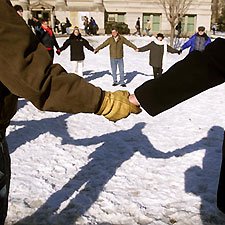
Calvin and Hobbes were filled with hope by a new snowfall. Life was filled with possibilities. The writer of the Hampton Road Supplemental Teaching Plan makes the point that we can live our lives doing the things that we love to do, but sometimes we need to do things for others when we really don’t want to.


These situations demand that we depend on the power of the Holy Spirit to fill us with hope, peace and joy. Is the Spirit prompting you at this time to do something for someone else? Doing it will bring glory to God and fill you with hope!

Thursday, February 09, 2006

How do you see others?

Step 4 of “Glorify God” is all about accepting others. Why? It results in praising God. See Romans 15:7-12. How would you make the point that acceptance leads to God’s praise?

Christians are diverse if in no other way than in the choices they make, but does God want us to simply “swallow” our differences and pretend to be happy with one another? No. He wants us to receive one another as Christ received us.

Have members roll up a sheet of paper into a tube and look around the room through it. How well do they see others with the tube and without the tube? Perspective matters! Remind members that people have many differences, ideas, opinions, and alternatives as to what works for them.

Ask members to privately rate their perspective from 1 (least) to 5 (most) on: “How accepting are you of others? How respectful is your speech toward others? How well do you resolve issues with others? How much do you engage in gossip about others?

Lead the class in prayer and ask God to lead us to accept others as Christ accepts each of us.

Wednesday, February 08, 2006

Are you the subject or the verb?

The LifeWay Leader Guide labels Step 3 of the lesson “Glorify God” as “Getting Along” (sound familiar?). It’s based on Romans 15:5-6, which reads like a prayer for Christians to come into agreement so as to glorify God together.

Paul also wrote about divisions over leadership styles (1 Corinthians 1:11-13). Control issues cause most church conflicts. J. David Hoke tells the story about a guy who can’t get along even with himself. Maybe you can think of other examples, but are you currently not in harmony with another Christian in your church? Is it mutual?

Subject and verb disagreement is an outlaw that writers catch to eliminate syntactically incorrect sentences. To illustrate “come into agreement”, I’m thinking of showing example sentences that contain subject and verb disagreements and having the class correct the errors (creates glorious English!). If needed, you can garner more examples from the exercises on this page.

I may stretch the illustration by asking members if they personally are a subject (needs action), or a verb (action oriented) with respect to some current disagreement. If so, what needs to change in order to achieve agreement? How would this agreement magnify God?

Tuesday, February 07, 2006

Scripture puzzle

The focal verses Romans 15:1-4 for Step 2 of “Glorify God” notes the example of Jesus to serve others. Paul says to follow his example in pleasing others, just as he followed the example of Christ (1 Corinthians 10:33-11:1). To me, the key point of Romans 15:1-4 is that we should have hope in what seems like a hopeless situation. After all, we can't change someone else can we? So we should demonstrate endurance and be encouraged by the Scriptures, which give hope. What verse has recently encouraged you? How are you demonstrating endurance right now? In what way are you hopeful as a result?

Jesus made the point (see Mark 9:38-39) that we should not forbid someone practicing Christianity just because that person is not one of us. Jesus also taught, “love your neighbor as yourself” (Matthew 22:39). Trey Turner’s comments on “Glorify God” begin with the question, “Is there such a thing as Christian ambition?”. He answers by saying we should be ambitious to glorify God by serving others.

Because it gets the class into the Scriptures, I like the Adult Leader Guide recommendation to use pack item 22 (pg. 146) in Step 2, but it is difficult for me because I teach a large class. What to do? What to do?

To achieve the same effect, I’m thinking of putting together a word search puzzle, or perhaps a simple crossword puzzle covering Romans 15:1-13 that the class can work as a group. I’ll fill in spaces as they call out answers to the clue words (verses). Below are the answer words followed by "clues" with a 60x60 puzzle.


endure bear with
others please
yourself love your neighbors as
hope Scriptures give
unity we have one body, Spirit, hope, Lord, faith, baptism, God
one glorify God together as
praise welcoming and accepting each other leads to
Jesus merciful servant
peace God grants
joy God gives
trust God of hope fills as we

Monday, February 06, 2006

Caring people

The goal of a Christian is to glorify God in all that he or she does (1 Corinthians 10:31). How we accomplish this is the focus of this week’s lesson “Glorify God”, which is based on Romans 15:1-13. The Study Questions from NetBibleInstitute might be helpful, especially if you get them out to members today.

We bring glory to God, or not, by our actions and attitudes. Why are Southern Baptists on a campaign to demonstrate that we are a “caring people”? We’ve produced at least one TV ad and published, “How we make a difference”. SBC Outpost fielded comments on the ad (mainly the posts are by pastors at SBC churches).

You might want to introduce the lesson by showing the ad and asking members their opinion about the image of Southern Baptists? Ask, “Are we known as a group of people that glorify God?” If not, “What are the key issues and what do we need to change in order to become known as people that glorify God?”

The goal is to start discussion with thea “big picture” and then have members apply Paul’s teaching personally as the lesson progresses.

Sunday, February 05, 2006

Site update

Thought I'd share with you some key insights regarding blogging on LifeWay Explore the Bible lessons the past eight months. Starting last May, the site now has almost 300 monthly visitors who view about 1,000 pages per month. The site ended January with 82 regular, returning monthly users and 37 weekly users. These individuals are anonymous for the most part (unless they identify themselves). Regular users (as opposed to visitors) make multiple visits to the site each month and spend time reading multiple pages. The highest number of visitors comes each Saturday although there is good traffic everyday except Sunday. The site is "syndicated" and currently has 11 subscribers.

Visitors mostly come from Texas, North Carolina, Michigan, Georgia, Virginia, Missouri, Florida, California, Tennessee, Louisiana, South Carolina, Illinois, New York, Indiana, Mississippi, Alabama, Kentucky, Colorado, Kansas, Oklahoma, and Washington. The site has incoming links from 5 other sites, but visitors find the site primarily through a search engine (eg. MSN, YAHOO, GOOGLE). The site has no connection with the LifeWay organization.

Site users leave very few comments. This implies that the material does not invite dialogue, or that teachers are not interested in discussing lesson preparation. For example, a "political" blog will garner heavy commenting as people share their opinions. A "cultural blog" on some current event will garner several comments per entry. However, a blog on Bible lesson preparation attracts an audience with practically no interest in dialogue. If this is a fact of life, then it may be more appropriate to team with other teachers to maintain the site. I’m praying for God to give me wisdom about this.

Awareness of the site remains low in my opinion. Ideally, it would be great if there was some way to create awareness among Baptist teachers in an efficient manner, but I know of no way to do this. One person suggested creating an email chain announcing the site. Any suggestions to improve the blog would also be welcomed! Without interaction and feedback, site changes are little more than stabs in the dark.

The blog reflects what I normally go thru in terms of lesson preparation. It is only extra work in the sense that the material must be formalized for blogging (as opposed to just sending myself a note thru email for later use in final lesson preparation).

I think of the blog as a virtual “teacher’s meeting” on lesson preparation. The goal is to suggest teaching ideas as opposed to providing a detailed lesson plan.

Thanks to all who use the site!

Blessings,
Ronnie

Saturday, February 04, 2006

Proverb meme

Which proverb most applies to the lesson “Guard Your Actions”? Why?

1. Prov. 14:13--Hold on to instruction, do not let it go; guard it well, for it is your life.
2. Prov. 14:23--Above all else, guard your heart, for it is the wellspring of life.
3. Prov. 13:3--He who guards his lips guards his life, but he who speaks rashly will come to ruin.
4. Prov. 16:17--The highway of the upright avoids evil; he who guards his way guards his life.
5. Prov. 22:5--In the paths of the wicked lie thorns and snares, but he who guards his soul stays far from them.

Friday, February 03, 2006

From a distance

In concluding his remarks on this lesson “Guard Your Actions”, I admire Dr. Sam Tullock for stating that he “may not always fall in the category of the ‘stronger brother.’” We all can admit to that, I think. The most mature believers in terms of years of service to Christ may be the weakest of believers when it comes to understanding and applying Christian liberty. Are you quick to second-guess the actions of others? What barriers do you erect that separates you from other Christians? Are these barriers matters of Christian liberty? Has God ever changed your mind about another Christian so that you now love that person as a brother or sister in Christ? What did you do to seek harmony in the relationship?

I’ve second guessed others at times, or declared the unacceptability of their public actions. I decided with little real information that the person angered me as a Christian (eg, a supposedly Christian lawyer, judge, reporter, politician, businessperson, teacher, etc.). Knowing them only from a distance, I held firm to an attitude of dislike. However, as God allowed me to get to know these people through personal contact, I realized the wrongness of my predisposition. In the context of this lesson, my attitude was the barrier I erected and it separated me from other Christians. Does this make sense to you? Close the lesson by having each member pray silently for another member in the class.

Thursday, February 02, 2006

Be part of the solution

Step 4 of this week’s lesson “Guard Your Actions” is summarized “Seek Positive Results” in the LifeWay Leader Guide. That keys on the first verse in Romans 14:19-23, which says, “19 So then, let us aim for harmony in the church and try to build each other up.” (NLT). Eric Taylor calls this altruism, which is an interesting word. Are you altruistic? I suppose being so implies one that for the sake of others is humble, forgoes rights and privileges, not argumentative and peaceful. Hmmm.

94% of pastors think positive results can result from conflict. Control issues are 85% of all sources of conflict in the church. Trey Turner notes “Christians can get embroiled in arguments about who is right and who is wrong just as any one else can.” Can you recall the last time you were involved in a “whose right, whose wrong” argument? How did it end? Based on Romans 14:19, what should you have done? You may be involved in such an argument now. If so, are you wiser and stronger now such that you can apply Romans 14:19 and achieve harmony? You may think it will get better on its own, but in prayer, ask the Holy Spirit to intervene now.

Wednesday, February 01, 2006

Danged if you do, and danged if you don’t

Step 3 of the lesson “Guard Your Actions” is focused on Romans 14:15-18, and the more clear rendering of these verses, I think, is given in the New Living Translation Romans 14:15-18. Verse 16 is tricky because it’s easy to miss the idea that we do have influence over whether others speak evil of us, or not. We exercise this power by controlling our actions. For example, in faith, you may believe social drinking is acceptable, but if practicing it brings harm to another person, you could be danged for causing their harm. You earn a bad name when you could have avoided it. The best habit then is not to drink (both publicly and privately—so as not to be hypocritical).

We can avoid earning a bad name by controlling our actions. That is a reasonable sacrifice to earn a good name before God and men, but some people (non-Christians, or Christians who drink socially) are likely to criticize you for NOT drinking alcohol in their presence. Why? When you abstain, you set yourself apart. Others see this separation as you assuming some moral high ground. This makes them feel inferior. To reduce your stature, they slander you. But we desire a good name before God and man (Romans 14:18), and if we must choose one over the other, we choose God.

The—garret* is a good source of Christian news items, and if you look around you can find some example applications of Romans 14:15-18 in today’s Christian world.

Tuesday, January 31, 2006

Mega barriers and pitfall traps

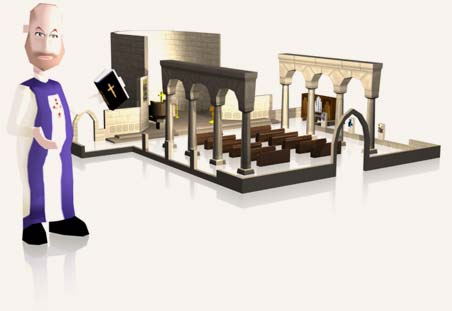
Now that the Internet is well accepted we have the online Church of Fools—a virtual community of believers. Don’t laugh, if the Lord tarries, the virtual church could be the new emergent church of the future (ha!). How you could apply the admonitions in Romans 14:13-14 in a virtual church setting? Would you criticize someone who “attends” a virtual church?

When Paul wrote Romans 14, there were no megachurches. This Forbes article regards mega churches as mega businesses. If you transported a believer from Paul’s day to one of these megachurches, what new applications of Romans 14:13-14 would he find? What barriers and pitfalls to fellowship would he observe?

Pitfall traps are commonly used in science. What is the equivalent of a pitfall trap in an ailing church fellowship? Look here for some ideas. Is the staff coming and going regularly at your church? Maybe it’s a pitfall trap?

Monday, January 30, 2006

Take it to a new level

In reading up on the recent IMB vote and related issues I liked the commentary from Fide-o's Pack of Poodles and associated wade-ing in post. I’ve added the Fide-O link to the right hand side of this page for easy reference.

With the help of the study questions from Net Bible Institute, yesterday’s lesson went very well. If it dragged anywhere, it was on the discussion about the IMB vote. My sense is that the average SBC person considers issues like the one with IMB by sleeping on it. I have to admit that I’m not much into it either, but regardless of what you think of private prayer language, it is a divisive issue that relates to the lesson “Consider Others”. In spite of the lesson, the infighting wages on.

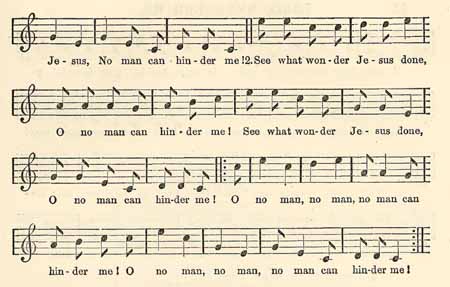
This week we continue in Romans by taking on verses 14:13-23 and learn to guard not only what we say, but also what we do. I like the courage represented in the old song “No man can hinder me”.

I think I read in Season of Life, by Jeff Marx, that like a carriage (coach) that moves its passengers from one place to another, a sports coach moves his players from a lower level to a higher level of play. So a coach not only guards his actions, but they are purposely planned to move players to a new level. As Christians, we should do likewise to help move others toward a new level of living with Christ as Lord and Savior.

Saturday, January 28, 2006

Time for reflection

To conclude the LifeWay lesson “Consider Others”, I’ll use the suggested conclusion offered by a teacher at Hampton Road Baptist Church.

Here are my final PPT slides for Consider Others.

Question: Do you mark in your Bible? Pencil, or Pen?

Friday, January 27, 2006

Playing God

Step 5 of “Considering Others” is based on Romans 14:10-12. Judging is God’s province. However, Christians want to play God and criticize, or look down on other believers. Our responsibility is to love one another. Only God knows the heart of man.

Just how serious is this issue? So great that Paul reminded believers of a coming universal judgment by God. Wow! The LifeWay Leader Guide (p. 99) indicates Paul essentially says, “How dare you?”!

Show a list of the names of local restaurants and ask members to call out the ones they prefer and the ones they dislike. Some people will like some places that others will dislike. Ask, “should we criticize one another over restaurant choices?” Of course not. “Should we look down on someone who likes to eat different foods than we do?” Of course not! It is silly to cause division over choice of restaurants.

Thursday, January 26, 2006

Just following my convictions

Step 4 of “Consider Others” is based on Romans 14:5-9. The key phrase is “to the Lord”. Paul is saying that our convictions should be “to the Lord”. How can we tell when someone is acting contrary to that and just following his own wishes?

Good examples of a “convictions controversy” can be found in what’s currently going on in the Southern Baptist Convention International Mission Board. Marty Duren, a Georgia pastor, has blogged extensively on the issues.

It seems that Marty is saying that IMB is trying to turn matters of personal conviction into doctrine. The two issues concern manner of baptism and use of prayer language.

Secondly, many other tangential issues have come to light (again, it seems that all are matters of personal conviction, not clear Scriptural teachings). For example, is the glue that holds SBC together primarily doctrine, or missions?

I don’t know the relevance of the current row to the local church. I say this since Paul was concerned about unity in the local church. That not withstanding, read thru Marty’s posts and see if you can determine what’s being done is “to the Lord”, or not. How can you tell?

Wednesday, January 25, 2006

Watch out!

Step 3 of “Consider Others” advises that we avoid criticizing others. Why? Roll a stone and it rolls back on you. Dig a pit for someone else and you’ll fall into it. Criticize someone else and it will backfire, or boomerang on you. When you are critical, you get criticized. You will be resented. So drop a matter before a dispute breaks out (Proverbs 17:14). How do you discern what matters to ignore?

But the deeper idea in Romans 14:3-4 is that God is in charge and if He has accepted someone, we should accept that person, too. Who are we compared to the Lord? Watch out! The shoes of a man with a big head are easy to fill. An offended brother is more unyielding than a fortified city (Proverbs 18:19). Can you speak the truth in love?

I’ve started preparing the PPT slides I will use this Sunday. Feedback about them from you would be greatly appreciated! The Blogger comment feature is easy to use.

Tuesday, January 24, 2006

Where do you draw the line?

For Step 2 of the LifeWay lesson “Consider Others”, use a 5-point rating scale of “never critical, rarely critical, sometimes critical, often critical, always critical” and ask “How would you rate your attitude about the convictions of others?” Also ask, “How would others rate your attitude about the convictions of others?” We learn to consider others in a library, but what about other believers in church?

The LifeWay Leader Guide asks (pg. 94), “On which issues do you find yourself being critical rather than considerate of other believers? Some suggestions: chronic late comers; people bringing a water bottle, or cup of Starbucks into the worship center; inert people that never say a word; divisive people; believers who lack discernment, or incorrectly apply the Scriptures; believers who criticize traditional holiday themes such as Santa Claus and the Easter Bunny. A church bulletin says “Please consider others by ending all conversations as you are seated.” Does that require the strong in faith to become weak, or the weak in faith to become strong?

An exercise you might try is to have members trace the outline of their hand on a piece of paper and compare it to others around them. Say, “Assume your hand represents your convictions. Are any two hands the same?” Of course not, but we accept each other as Paul advises us to do in Romans 14:1-2.

Monday, January 23, 2006

Drinking, dancing, dressing

You could use creative tension to start the unit “Live in Unity”. The first lesson is “Consider Others” from Romans 14:1-12. Troy Bush makes it clear that the discussion is about matters where “weakness of faith” is in question, not open rebellion. For example, the Bible is very clear on teaching sexual purity, but not so clear on social drinking (not drunkenness), celebratory dancing, and customary dress. I’d like to know what you think? Do you agree, or not?

To live in impurity is rebellion, but to socially drink, dance in celebration or customarily dress differently than other Christians involves conviction. To illustrate, I recently attended a wedding between two Christians. I was tempted to judge the drinking, dancing and manner of dress by the hosts, but decided breaking fellowship was the wrong course of action. I said nothing since their action did not impact their Christian witness. What would the Holy Spirit have you do?

Start the lesson by introducing controversial topics such as manner of wedding celebration, working hard to “get ahead”, organizational membership, style of music, work on Sunday, going into debt, etc. While opinions may differ, “Should Christian unity be sacrificed because of these differences?” What to do? Answer: “Consider Others”.

Saturday, January 21, 2006

Meme next door

Use the comment link to answer:

1. How much time do you have to teach on Sunday? 15, 30, 45 minutes?

2. What Bible translation do you use?

3. Do you use an overhead projector, a computer projector, or no projector?

4. Is your class interactive, or do you primarily lecture?

5. Do you know the names of your neighbors on each side of where you live? Yes? No?

Friday, January 20, 2006

Power to be a Godly neighbor

To conclude this lesson “Live as a Godly Neighbor”, summarize the teachings of Romans 13:1-10,12b-14 as the Leader Guide suggests (p. 90). But I suggest taking time to make the point that we cannot escape the deeds of darkness on our own without the light of Christ. We all struggle with personal sin as we are tempted by the world around us, and the armor (shield) of the light of Christ is our only consistent and effective defense. Invite members to enter into personal faith and belief in the power of Christ Jesus to change any individual into a Godly neighbor. Lead in a time of prayer.